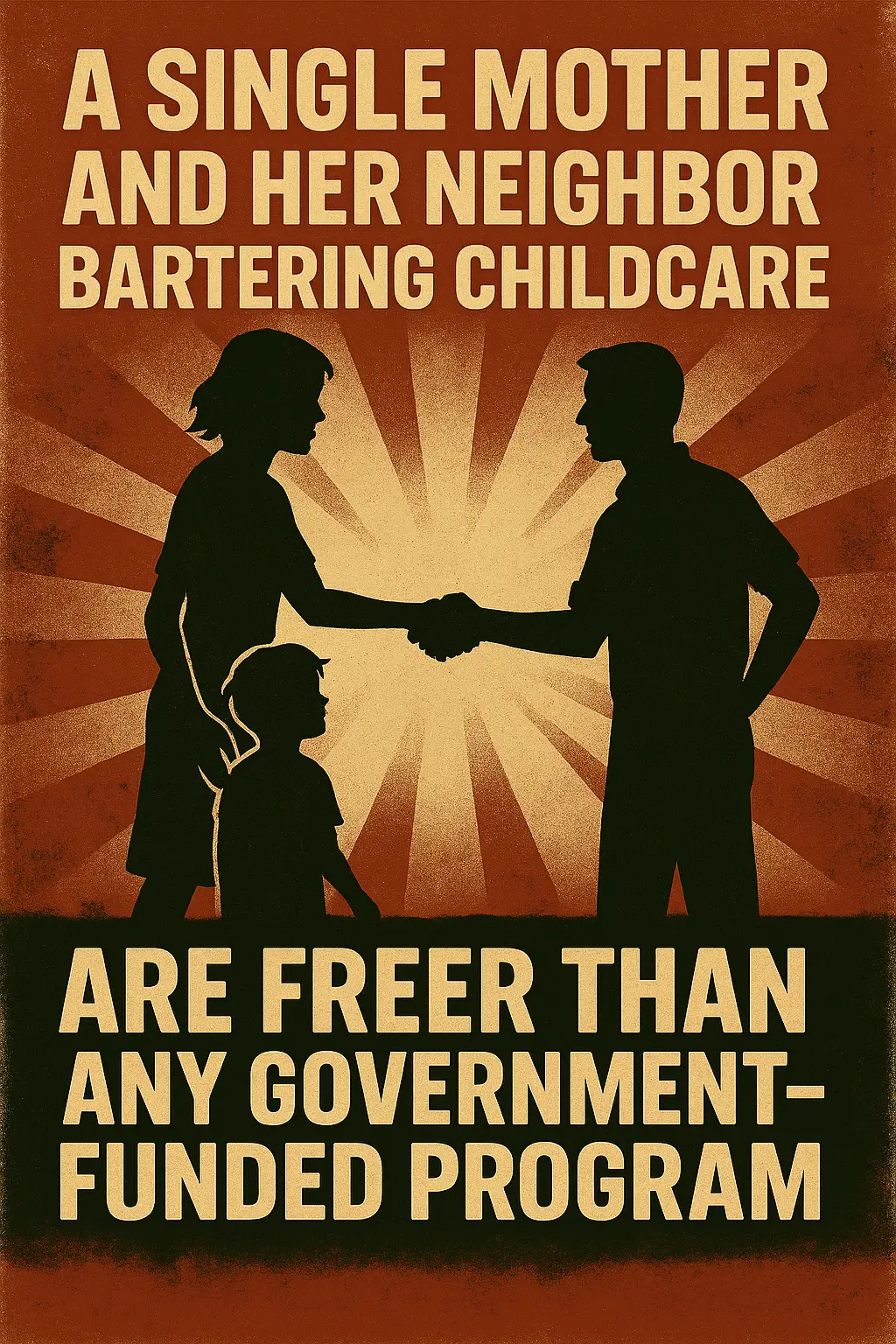

Picture this: a single mother, juggling work, dinner, laundry, and the relentless demands of parenthood, finds herself with a problem—childcare. Down the street, her neighbor, a retired grandmother, loves kids but isn’t looking for a formal job. Instead of navigating paperwork, licenses, and state “childcare assistance” forms, they do something radical in its simplicity: they make a deal.
“I’ll watch your kids on your late shifts,” says the neighbor, “and you help me with grocery runs and yard work.”
No applications. No government forms. No “approved provider” registry. No payroll taxes. Just two people trading value. That’s voluntary exchange in its purest form—and it’s freer than anything the state could design.
Why Barter Beats Bureaucracy
Government-funded programs always come with strings. They tell you how you can get help, who you can get it from, and what hoops you must jump through to qualify. They turn life’s most basic needs into administrative processes.
Bartering flips the script. There are no gatekeepers, no waiting periods, no “case workers” deciding if you deserve help. It’s self-organized, self-regulated, and built on trust.
When you barter, you’re not a case file—you’re a human being in a mutually beneficial relationship. You keep the value you create, instead of having it skimmed off by layers of bureaucracy.
The Illusion of Government Generosity
Politicians love to paint government programs as “free,” but they’re not free—you’ve already paid for them through taxes, and usually at a terrible exchange rate. For every dollar the state “gives” back to you, they took much more from someone else (including you), filtered it through an expensive bureaucracy, and returned it as a fraction of its original value.
In the barter economy, 100% of what’s traded stays between the people who made the deal. No middleman. No budget hearings. No political leverage.
Parallel Economies Are the Real Safety Net
This isn’t about rejecting all forms of aid—it’s about recognizing that the strongest safety nets are woven at the community level. Mutual aid, informal agreements, and local trade networks can do what bureaucracies never will: adapt instantly to people’s needs.
Government programs are rigid by design. Barter is fluid. The rules can change in five minutes with a conversation, not five years with a policy rewrite.
The Political Threat of Everyday Freedom
Here’s the part the state doesn’t like: barter erodes its control. If people start solving their own problems without asking permission, they stop seeing the state as necessary. And once you realize you don’t need someone’s “authority” to live well, you start questioning all the other ways they’ve claimed power over your life.
That’s dangerous to them. Because a nation of people who can solve problems without bureaucrats is a nation that can govern itself.
This is DAC in Action
In The Blueprint for a Stateless Society, I argue that the foundations of a free world aren’t built in marble capitals or on parliamentary floors—they’re built in kitchens, garages, backyards, and coffee shops.
A single mother bartering with her neighbor is a microcosm of Divine Anarcho-Capitalism: voluntary exchange, local trust, zero coercion. It’s proof that we don’t need to wait for political permission to start building a freer society.
The real revolution won’t start with a protest sign—it will start with a handshake.