
The other day I was in a Facebook group when someone asked: what song should play every time you walk into a room?
Most people gave the usual safe answers — Darth Vader’s theme, Eye of the Tiger, some pop-punk staples.
My answer came instantly:
“Perfect World” by Guttermouth.
I’ve been a Guttermouth fan for over thirty years, following Mark Adkins and the band since the mid-’90s. People have all sorts of opinions about them (and Mark), but to me they’re one of the most honest, unfiltered punk rock bands ever. I’ve seen them live at least twenty times since 1995 — the first time being while I was in college down in SoCal.
Fast forward to today: I just saw them again at Punk in the Park in San Pedro. Mark actually signed my Guttermouth hat — which is wild because he doesn’t sign anything. He’s a good dude. Coincidentally, Smelly from NOFX signed the same Guttermouth hat that day — and he’s the one who lent me the marker Mark used to sign it. (That’s a whole story in itself.) But I digress.
That show got me thinking about the lyric that’s been burned into my brain since the first time I heard it:
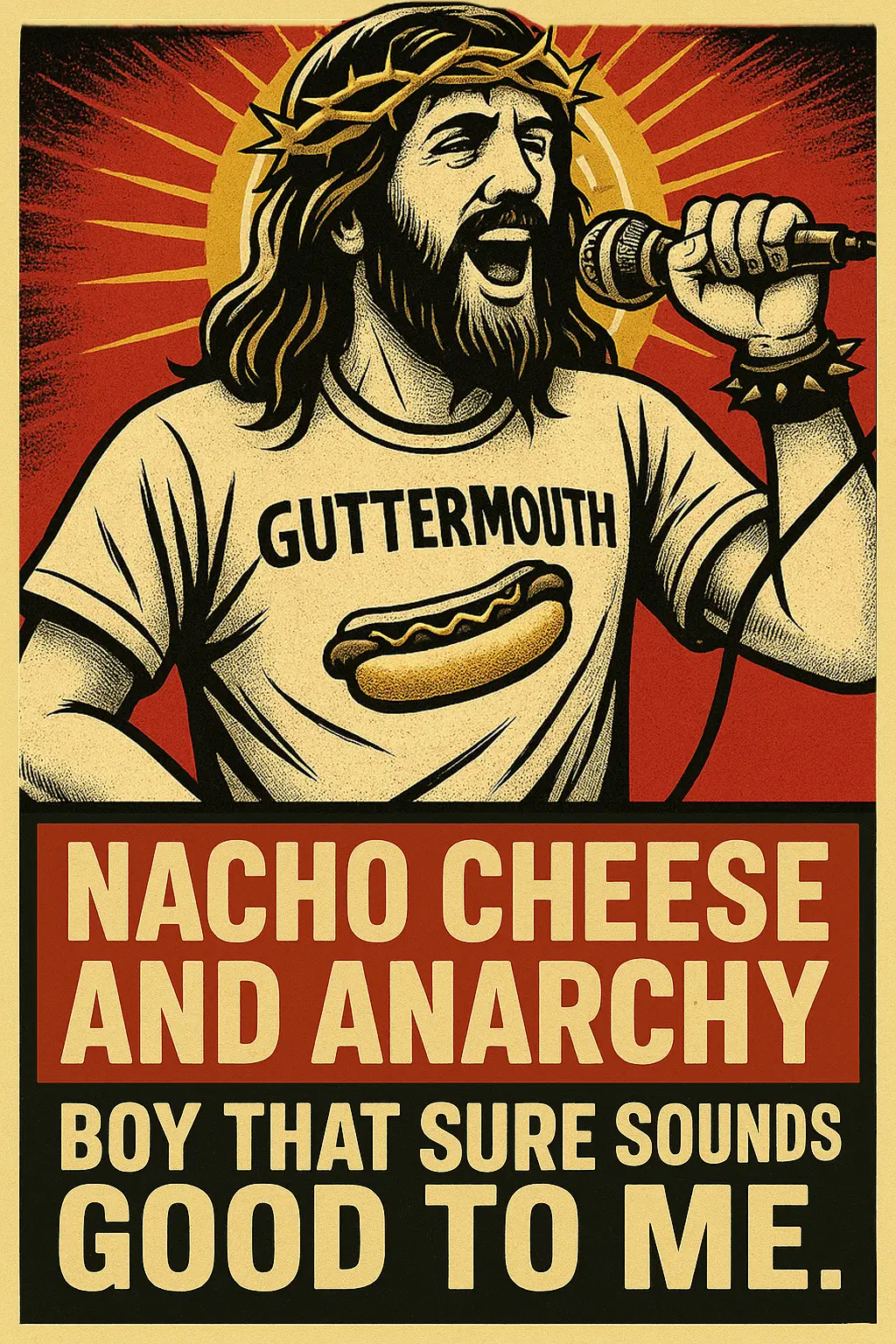
“Nacho cheese and anarchy, boy that sure sounds good to me.”
I started asking myself why — after almost thirty years — that line still hits harder than any political quote or manifesto. Why not “I Want to Conquer the World” by Bad Religion, or something more overtly ideological?
Because Guttermouth, intentionally or not, captured freedom in its most honest, human form — at least that’s how I interpret it.
The Paradox of Stupid Genius
“Nacho cheese and anarchy” sounds ridiculous — and that’s the point. It’s satire, it’s rebellion, it’s punk, it’s absurd. It’s saying freedom doesn’t need to be packaged, moralized, or intellectualized. You can laugh and still mean it.
It’s the same reason people connect more with a two-minute punk song than a twenty-page political essay: truth hits harder when it’s loud, fast, and funny.
“If I lived in a perfect world…”
The song opens with escapism.
“If I lived in a perfect world
I would spend my days lying in the sun
The party never ends in a perfect world.”
This is the false dream — the consumerist fantasy of a world where comfort never ends and nothing is earned.
It’s the illusion sold by governments, corporations, and the status quo: “Let us manage your freedom, and you’ll never have to think again.”
But Guttermouth’s delivery drips with sarcasm. The “perfect world” here is actually dystopian — pleasure without purpose, freedom without responsibility, happiness on credit.
In Divine Anarcho-Capitalism, the perfect world isn’t one where everything’s free and effortless — it’s one where you own your life, and every exchange is voluntary.
Freedom means consequences.
Ownership means responsibility.
That’s what makes it real.
“Nacho cheese and anarchy…”
This is the heart of the song — a declaration disguised as a punchline.
“Nacho cheese and anarchy
Boy that sure sounds good to me
Every kind of drug is free
In the new America.”
He’s mocking both sides — the authoritarian “law and order” crowd and the fake rebels who only want state-approved chaos.
But the beauty is that the line still rings true if you strip the sarcasm.
Freedom should taste good — messy, indulgent, and voluntary. Not handed down by a bureaucrat or sanitized by a committee. You don’t need permission to enjoy what you love. That’s anarchy.
“Shoot your pistol in the air, celebrate a brand new year.”
To me, that’s America’s ritualized illusion of freedom — fireworks, flags, noise, distraction.
People think celebration equals liberty. But the true celebration is ownership — of your life, your choices, your labor. Anarchy isn’t about chaos in the streets; it’s about order without coercion.
“Everybody’s drinking Hamms, goodbye all you straight-edge bands.”
This verse pokes at subcultures that turn rebellion into conformity. Even punk can become dogma if it starts policing behavior (the straight-edge scene of the ’90s).
True anarchy means you do you — whether that’s sobriety, excess, or anything in between — as long as it’s voluntary. Being punk is accepting differences.
That’s the sacred principle of Divine Anarcho-Capitalism:
“You own you.”
No rulers. No victims. No guilt for being yourself.
“When I turn on my TV, nothing but pornography…”
Guttermouth paints the “perfect world” as moral collapse — not because he’s moralizing, but because he’s reflecting how society defines freedom.
The mainstream sees freedom as license — consumption without thought. That’s not anarchy. That’s slavery to appetite.
Real freedom isn’t the absence of morality — it’s morality without force. It’s doing right because it’s right, not because you’re threatened with punishment.
“Nothing in this world’s for free, ’cause everything belongs to me.”
This line flips everything. It’s self-ownership twisted into greed — satire of capitalism without ethics.
But read it through the lens of Divine Anarcho-Capitalism, and there’s a kernel of truth:
Freedom begins with ownership — of yourself, your labor, your mind. It becomes corrupt only when ownership extends over others.
That’s where the State lives — in the idea that you can own what isn’t yours. That you can tax, regulate, or cage in the name of “the greater good.”
“If your life has hit the skids…”
This refrain — “wave goodbye to the wife and kids” — repeats like a warning. It’s the anthem of people escaping the machine, whether through humor, rebellion, or madness.
But maybe that’s what punk has always been — the recognition that normal life isn’t freedom. Sometimes you have to walk away from the illusions to find yourself.
The Punchline with Teeth
After all the sarcasm and chaos, Perfect World leaves you laughing — but uneasy. Because deep down, you realize it’s not really parody.
It’s prophecy.
We’ve built a culture addicted to comfort, blind obedience, and digital outrage. We trade freedom for safety, truth for convenience, and rebellion for branding.
Guttermouth saw it coming — and turned it into a two-minute joke with nacho cheese on top.
That’s why, nearly thirty years later, that song still hits like a beer bottle to the skull. Because beneath the laughter, it’s saying exactly what Divine Anarcho-Capitalism says:
“Freedom is voluntary, messy, personal, and divine.”
The world doesn’t need to be perfect — it needs to be free.
Final Thoughts
“Nacho cheese and anarchy” isn’t a call for chaos — it’s a toast to self-ownership. It’s the punk reminder that life, at its best, is unregulated joy.
So yeah — nacho cheese and anarchy.
That sure sounds good to me.