
Pre-Requisite Articles:
Deriving the Invariant
The Invariant
This document proposes a core model for anarchist systems — a hub of invariant constraints from which all voluntary societies (spokes) may be built.
It is published as a Request for Comments (RFC) for peer review and collaborative refinement.
This RFC aims to operationalize the definition of Anarchism.
—
Everybody wants to jump straight to the sexy stuff.
It’s all over the comments of the first two articles.
Property.
Contracts.
Privacy.
Markets.
Defense.
Dispute resolution.
How to build a stateless society without it turning into Mad Max with LLCs.
Cool. Me too.
But before any of that, there’s a more basic question sitting underneath the whole thing:
Who the hell is actually agreeing to anything?
Because if we can’t answer that, then all the talk about voluntary order isn’t real.
If anarchism means voluntary order without rulers, then voluntary order only works if there are actual agents capable of choice, continuity, and accountability. If that falls apart, the whole model falls apart with it.
That’s what this article is about.
Not identity in the state sense.
Not passports.
Not social security numbers.
Not some bureaucrat stamping your forehead and telling you that you officially exist.
I’m talking about identity in the only way that matters structurally:
the persistent locus of agency that makes consent and accountability possible over time.
Simple Start: What is an Agent?
If you strip away all the political nonsense, an agent is just an entity capable of making choices and being tied to them.
That’s it.
Not a citizen.
Not a voter.
Not a government file folder with a pulse.
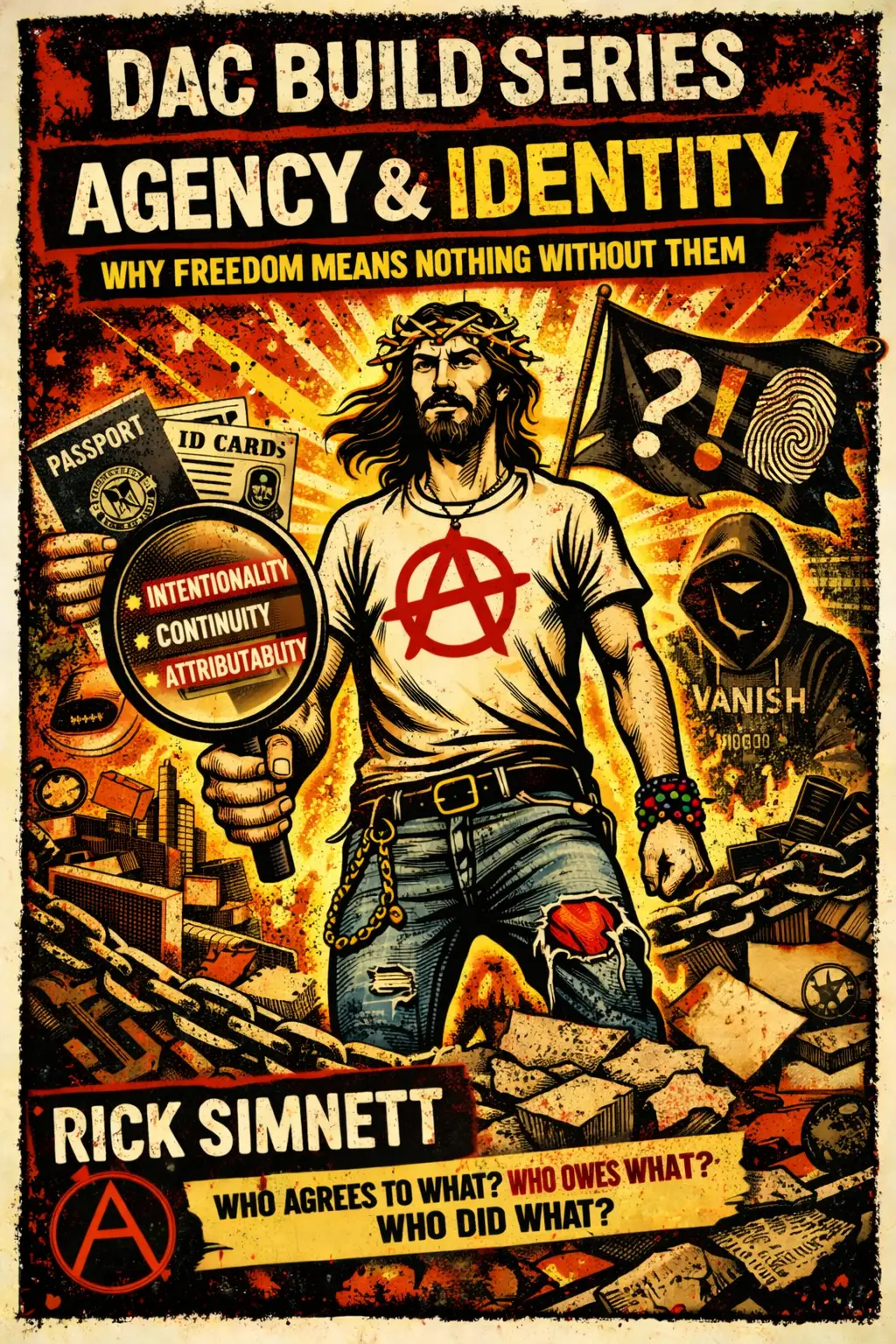
If a voluntary system is going to function, an agent needs three things:
Intentionality
Continuity
Attributability
Lose any one of those and the whole thing collapses like a house of cards.
- Intentionality
This one’s easy.
An agent has to be capable of preference and choice.
If there’s no ability to choose, there’s no consent.
And if there’s no consent, stop calling it voluntary.
It isn’t.
This is the point a lot of political systems love to blur.
They use words like “participation” and “representation” and “social contract”.
They say that creates consent.
It doesn’t.
If I didn’t choose it, and I can’t refuse it, that’s not consent.
That’s a ruler.
- Continuity
This is where things start getting interesting.
Let’s say you agree to a contract today.
Tomorrow you say:
“Actually that wasn’t me.
New haircut.
New username.
New wallet address.
New city.
New vibe.
Fresh start, baby.”
Cute.
Does that erase the obligation?
Of course not.
Because if obligations disappear every time someone changes labels, then contracts are worthless, trust is dead, and accountability becomes a joke.
So continuity matters.
The agent has to persist through time in a way that others can still recognize and relate back to prior commitments.
That doesn’t mean the system needs some central registry or government database.
It just means there has to be enough continuity for other people to say:
Yeah, that’s still you. You made the promise. You own the obligation.
That continuity might be preserved through reputation.
It might be preserved through witness testimony.
It might be cryptographic.
It might be social.
It might be contractual.
The mechanism can vary.
The outcome cannot.
The hub does not mandate the spoke.
It just mandates continuity sufficient for accountability.
- Attributability
This is the part that connects action back to agency.
Can commitments, actions, promises, fraud, damage, cooperation, or breach actually be tied back to the same agent?
If not, then contracts collapse.
Reputation collapses.
Trust collapses.
And so does any serious claim to voluntary order.
Because voluntary order isn’t just about being left alone.
It’s also about consequences.
A world without rulers is not a world without accountability.
It’s a world where accountability doesn’t come from sovereign override.
Big difference.
Identity Is Not a Government Product
This is where statists and a lot of confused libertarians both get their panties in a bunch.
They assume identity has to be granted from the top down.
Passport.
Birth certificate.
National ID.
Biometric registry.
Some giant centralized database watched over by people who absolutely, definitely, pinky swear would never abuse it.
Sure.
And strippers love you for your personality.
Identity does not require a ruler to validate it.
The second it does, the issuer becomes sovereign.
The registry becomes a power center.
And now you’ve rebuilt rulership through administration.
That fails the model immediately.
If anarchism is voluntary order without rulers, then identity cannot depend on compulsory recognition from a central authority. That’s just statism wearing a fake mustache.
But Pure Anonymity Doesn’t Work Either
Now let’s swing to the other extreme, because this is where some people get lost.
They hear “no centralized identity authority” and think that means total anonymity should be the standard.
Nope.
That breaks too.
If agents can act with no traceable continuity at all then:
Nobody can build trust.
Nobody can accumulate reputation.
Nobody can verify obligations.
Nobody can distinguish honest trade from fraud dressed up in a trench coat.
Pure anonymity kills accountability.
Mandatory identity infrastructure kills freedom.
So the answer sits on a knife edge:
enough continuity for accountability, without compulsory infrastructure that creates a ruler.
That’s the balance.
Attribution Is Not Surveillance
This distinction matters, because people love to intentionally blur it.
Surveillance is continuous, non-consensual observation.
Attribution is something else entirely.
Attribution is the property by which a commitment or action can be linked to a specific agent for the purpose of resolving disputes arising from that commitment or action, without enabling continuous monitoring of that agent’s unrelated activities.
A voluntary society does not require everyone to be tracked all the time like livestock with smartphones.
It requires enough attribution that promises matter, fraud can be identified, and reputation has some actual teeth.
Permitted?
Voluntary reputation records.
Cryptographic verification.
Witness testimony.
Mutual attestation.
Not permitted?
Compulsory tracking.
Forced biometric enrollment.
Always-on monitoring without consent.
One preserves accountability.
The other creates rulership with a dashboard.
Recognition, Not Permission
This part is important.
Identity is not something granted to you by a sovereign.
It is recognized by other agents.
That recognition is polycentric.
No single registry gets to define whether you exist.
No universal database gets to decide whether your commitments count.
No ruler gets to issue your ontological hall pass.
In a voluntary system, recognition happens when other people treat you as continuous, accountable, and capable of binding agreement.
That’s not permission to be.
That’s the basis for accountability.
So Let’s Test It
State-issued mandatory ID?
Fails.
Because central issuance creates a sovereign identity authority.
Pure unlinkable pseudonymity?
Fails.
Because complete unlinkability destroys accountability.
A persistent pseudonym with reputation attached?
Passes.
Because continuity and accountability can still exist without coercive infrastructure.
A voluntary web-of-trust model?
Passes.
Because recognition is distributed and accountability still functions.
Can you escape obligations by changing your name, your key, your location, or your profile pic?
No.
That fails too.
Because obligations attach to agency, not to labels.
Why This Matters
This is not a side issue.
This is foundation-level stuff.
Without agency, there is no voluntary order.
Without continuity, there is no obligation.
Without attributability, there is no contract.
So before we get to property norms, defense systems, privacy models, arbitration, or any of the other moving parts of a stateless order, we need to establish the minimum structure that makes freedom intelligible in the first place.
And that means identity cannot be a state artifact.
It also cannot be a disposable costume.
It has to be continuous enough for accountability.
Voluntary enough to avoid rulership.
Attributable enough to preserve consequence.
That’s the constraint.
Everything else gets built on top of it.
Because freedom is not the absence of all consequence.
It is the absence of rulers.
And if your system cannot identify who agreed to what, who owes what, or who violated what, then you do not have freedom. You have a void in accountability. And voids in accountability do not remain empty for long.
They invite governance, centralization, and rulership by whoever claims the authority to resolve the chaos.