
They say regulation protects you.
They say licensing ensures quality.
What they don’t say — and will never admit — is that both are weapons of control, designed to keep you in your place while the powerful profit.
It doesn’t matter how pretty the language sounds.
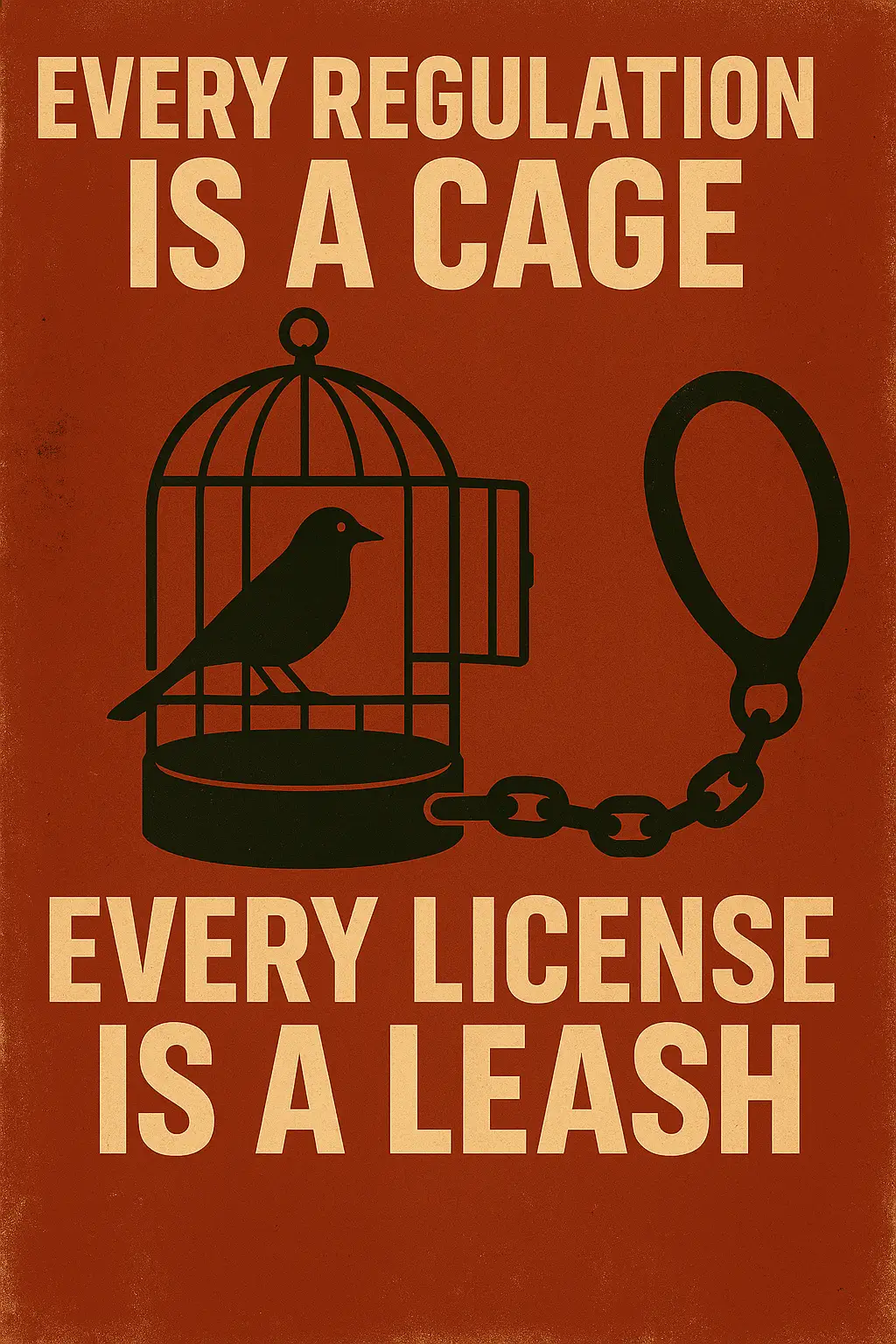
A cage can be painted gold, lined with velvet, and filled with food.
It’s still a cage.
A leash can be braided from silk, worn with pride, and given slack.
It’s still a leash.
The Cage of Regulation
A regulation is not a suggestion. It’s not a friendly tip from the State. It’s an order — backed by force. If you disobey, the best you can hope for is a fine. The worst? Prison. Or worse.
When the government “regulates” your business, it isn’t simply ensuring safety. It’s granting itself the power to decide whether you can even operate. It’s the slow suffocation of permission culture:
- Want to sell food? Ask permission.
- Want to build a home? Ask permission.
- Want to innovate in medicine, transportation, or energy? Ask permission.
And you don’t just ask once. You keep asking — every renewal, every audit, every inspection. You pay fees for the privilege of not being shut down.
Regulation isn’t about making you safe. It’s about making you dependent. When you need permission to survive, the State owns you.
The Leash of Licensing
Licensing is the collar around your neck. It’s the legal admission that you are not free — you’re conditionally free. Your ability to act is contingent on ongoing compliance with the arbitrary whims of those in power.
They say licensing “maintains standards.” But if that were true, markets wouldn’t already do it better. In a free market, bad actors fail because customers stop paying them. Reputation, reviews, and repeat business are far more effective — and far faster — than a bureaucrat’s rubber stamp.
Licensing has nothing to do with quality. It’s about exclusion. It’s about limiting competition. It’s about creating artificial scarcity so that only those willing to play by the State’s rules — and pay the State’s fees — can operate.
The Illusion of Safety
You’ll hear the same mantra over and over: “It’s for your protection.”
Protection from what? From making your own choices? From trusting your own judgment? From the consequences of dealing with dishonest people — as though you’re too stupid to avoid them without government intervention?
This “safety” is a scam. It’s protection the way the mob offers “protection” — you pay them so they don’t break your legs. Government protection operates on the same principle: pay them, obey them, and they won’t destroy your livelihood.
Real safety comes from consent, transparency, and personal responsibility. You don’t need a license to trust your mechanic if he’s fixed cars in your community for 20 years and his customers swear by his work. You don’t need a government seal to know whether a restaurant is clean if you can walk in and look for yourself — or check dozens of independent reviews online.
How the Cage and the Leash Work Together
Regulations are the walls. Licensing is the chain. Together, they form a system designed to keep you exactly where you are.
You can’t climb the walls because the leash keeps you tied down.
You can’t slip the leash because the walls keep you trapped inside.
This is how the State maintains control without you even realizing it. You think you’re moving freely, but your range of motion is carefully restricted. Your energy is spent pacing inside the cage instead of breaking out of it.
The Blueprint Alternative
The Blueprint for a Stateless Society doesn’t just critique this system — it offers a replacement. Imagine a society where:
- Rules come from mutual agreements, not decrees from above.
- Quality is ensured by competition, not coercion.
- Accountability is enforced by contracts, not monopolies on violence.
In a stateless society, the role of “regulation” is replaced by voluntary associations, consumer watchdog groups, and insurance-backed standards. These systems have every incentive to work — because if they fail, they lose trust and revenue.
Licensing is replaced by open reputation systems. If you’re skilled, honest, and deliver value, people will hire you — no permission slip needed. If you fail, the market will deal with you swiftly and fairly.
Cutting the Leash, Breaking the Cage
The first step is psychological: stop believing you need permission to live your life. Once you see the bars, you can start looking for the door.
The second step is practical: build and support alternatives. Choose products, services, and networks that operate outside the State’s permission structure whenever possible. When enough people refuse to wear the collar, the leash becomes useless. When enough people ignore the walls, the cage loses its power.
The Blueprint isn’t theory. It’s a roadmap for replacing coercive systems with cooperative ones, from the ground up. It scales from a handshake between two people to a marketplace spanning millions — without ever putting a leash around anyone’s neck.
Like what you read? This is exactly what The Blueprint for a Stateless Society advocates — dismantling the cages of regulation and cutting the leashes of licensing, replacing them with systems of voluntary exchange and accountability. Want to see how it works from the street corner to the global marketplace? Download the Blueprint and see for yourself.