
Pre-Requisite Articles:
Deriving the Invariant
The Invariant
Agency & Identity
Coercion
This document proposes a core model for anarchist systems — a hub of invariant constraints from which all voluntary societies (spokes) may be built.
It is published as a Request for Comments (RFC) for peer review and collaborative refinement.
This RFC aims to operationalize the definition of Anarchism.
—
Everyone says they care about privacy.
But almost nobody can define it.
And because of that, we get two equally stupid outcomes:
Total surveillance
Total secrecy
Both break the model of Anarchism.
Both create power. Both create rulers.
So let’s figure out what is compatible and what isn’t.
Mistake 1: Thinking Privacy Means “Hide Everything”
People hear “privacy” and think:
“No one should be allowed to know anything about me.”
Sounds good, right?
Until you think about it for five seconds.
If I can lie to you, scam you, screw you over, and then say:
“Sorry bro, privacy.”
What happens?
Contracts break.
Reputation dies.
Trust disappears.
Now nobody knows who screwed who.
That’s not freedom.
That’s chaos.
And chaos doesn’t stay chaos for long.
It gets replaced by control.
Enter power and rulers again.
Mistake 2: Accepting Surveillance as “Normal”
Now swing the other direction.
You’ve got governments, corporations, apps, devices—basically everything—tracking:
Your location
Your messages
Your purchases
Your behavior
All under the excuse of:
“security”
“convenience”
“personalization”
Yeah. Ok. Sure.
And fiat holds real value.
Let’s call it what it is:
If someone is collecting your information without your consent…
That’s not “data collection.”
That’s coercion.
So What the Hell Is Privacy?
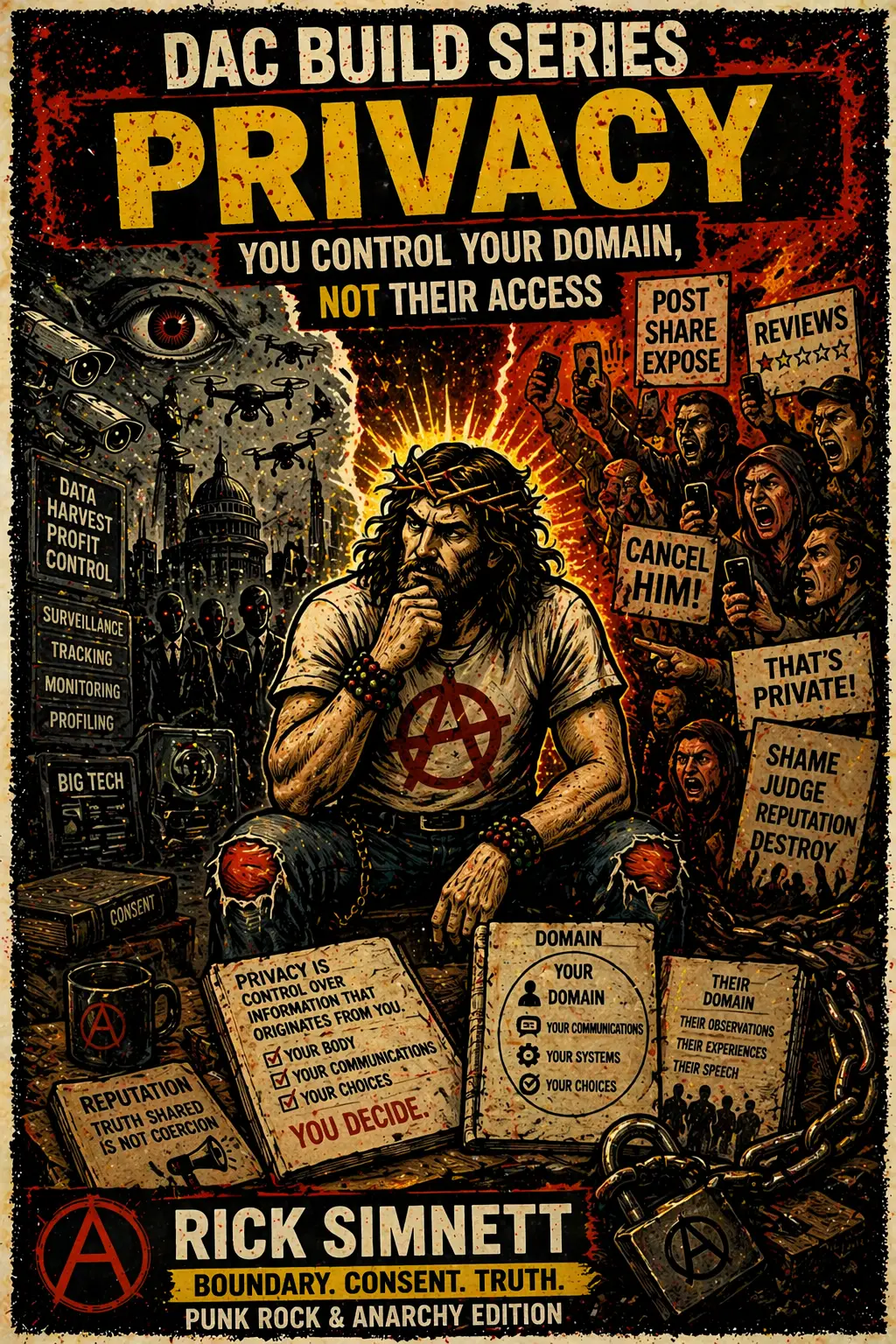
Privacy is your control over information that originates from you.
That’s it.
Your body.
Your communications.
Your choices.
You decide what gets shared.
Not the government.
Not a corporation.
Not a mob.
You.
But Here’s the Part Everyone Hates…
Privacy does not mean control over other people’s reality.
If I interact with you…
If I see something…
If I experience something…
That information exists in my domain, not yours.
Which means:
You don’t get to control whether I tell the truth about it.
Let that sink in.
Because this is where people start getting uncomfortable.
Example: “Don’t Talk About Me”
Let’s say you screw me over in a deal.
I go online and say:
“This guy didn’t honor his agreement.”
You respond:
“That’s private. Take it down.”
No.
That’s not privacy.
That’s you trying to control my speech and memory.
And the second you can do that…
You become a ruler.
That fails the entire system.
Reputation Isn’t Coercion
This is where people lose their minds.
Reviews. Ratings. Public feedback.
They say:
“That’s harmful. That’s coercive.”
No.
Truthful reputation is how voluntary systems function.
If people can’t share their experiences:
Fraud becomes invisible
Bad actors become untouchable
Trust collapses
Reputation isn’t the problem.
Lying, trespassing, or threatening to expose someone is.
Truth isn’t coercion.
The method matters.
Example:
You run a bad business.
I leave a one-star review.
You say that’s coercion.
It’s not.
It’s information.
The coercion would be me saying:
“Pay me or I’ll leave a fake review.”
That’s initiation.
That’s the difference.
“What About Doxxing?”
Good question.
Because this is where people try to blur the line.
If someone hacks, tricks, or forces their way into your data?
That’s a violation.
That’s coercion.
But if someone shares:
Public info
Info you gave them
Info they observed themselves
That’s not coercion.
Intent doesn’t matter.
Method does.
The Real Boundary: Domain
This is the key idea most people never think about.
There are two domains:
Your Domain
Your body
Your communications
Your private systems
You control this.
No one gets access without your consent.
Everyone Else’s Domain
Their observations
Their experiences
Their speech
You don’t control this.
And if you try to…
You’re asserting authority over them.
Which means…
You’re trying to become a ruler.
Attribution vs Privacy (They’re Not Opposites)
This is where people get confused.
It confused me at first.
Attribution is about linking actions to agents for accountability.
Privacy is about controlling access to your domain.
They’re not in conflict.
They’re two constraints the same system has to satisfy.
If you kill attribution, accountability dies.
If you kill privacy, sovereignty dies.
You need both.
Surveillance vs Observation (Big Difference)
People love to mix these up.
Surveillance:
Continuous
Non-consensual
Intrusive
FAIL.
Observation:
Public
Voluntary
From your own domain
PASS.
If I watch you in a public place…
That’s not a violation.
If I install cameras in your house…
Now we’ve got a problem.
Businesses Abuse This All the Time
Let’s bring this back to reality.
You’ve seen this:
“We collect your data to improve your experience”
“We may share information with trusted partners”
“By using this service, you agree…”
Buried in 40 pages of legal garbage no one reads.
What’s actually happening?
Scope expansion.
You agreed to use a product…
They turned that into permission to harvest your data.
That’s not consent.
That’s deception.
You agreed to use the product.
You didn’t agree to become the product.
That’s binding without agreement.
Which makes it…
Coercion.
You’re using these products every day.
Your favorite apps:
Google
Facebook
Instagram
TikTok
and many more…
All use coercion as a tactic against you and most people don’t even realize it.
Privacy in Contracts
Now here’s where it gets interesting.
Privacy can be part of an agreement:
NDAs
Confidentiality
Trade secrets
All good.
As long as:
It’s agreed upfront
It’s clearly defined
It doesn’t hide fraud
The moment secrecy is used to:
Conceal defects
Hide risks
Mislead participants
It stops being privacy…
And becomes coercion.
Whistleblowing Isn’t the Enemy
People love to hate whistleblowers.
But structurally?
They’re doing something important.
If someone exposes fraud or coercion…
That’s not a violation of privacy.
That’s self-defense for the system.
Same logic as physical self-defense:
You’re not initiating.
You’re stopping something that already violated consent.
You know Edward Snowden, Julian Assange…
all acceptable under this model.
The Two Ways Privacy Fails
Every bad system breaks in one of two directions:
No Privacy
Everything is visible
Everyone is tracked
→ Surveillance
→ Control
→ Rulers
Absolute Privacy
Nothing can be shared
No one can speak
→ No accountability
→ No trust
→ Collapse
Both fail.
Every time.
The Way Privacy Can Work
Privacy has to sit in the middle:
You control your information.
You don’t control the truth others experience.
That balance gives you:
Freedom without surveillance
Accountability without domination
Let’s simplify the entire thing into rules:
Taking or exposing your information without consent → coercion
Lying or hiding material truth → coercion
Telling the truth about your own experience → not coercion
Trying to control someone else’s speech → rulership
That’s it.
Final Thoughts
Privacy isn’t about hiding.
It’s about control.
But not total control.
Because the moment you control what others can say about reality…
You’ve crossed the line.
You’re not protecting yourself anymore.
You’re trying to rule.
Privacy isn’t the system.
It’s one of the constraints that keeps the system from turning into surveillance or control.
The moment privacy is used to override consent, accountability, or agency…
It stops being privacy and becomes rulership.