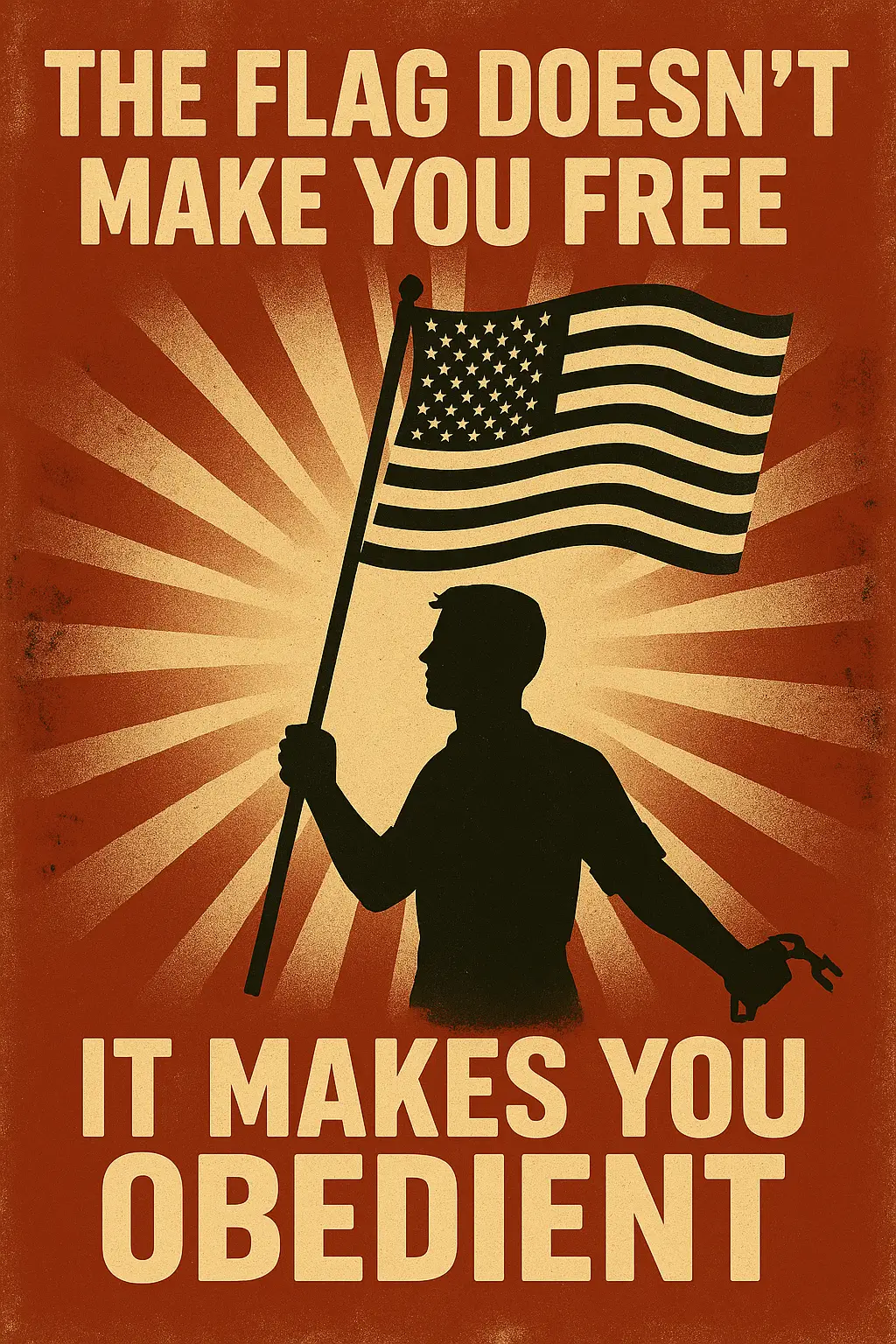

A flag is a piece of fabric. It can be beautiful. It can be inspiring. But it can’t grant freedom.
What it can do — and what it’s been expertly used for throughout history — is train obedience.
From the time you’re a child, you’re taught to stand in front of it, hand over heart, reciting an oath you didn’t write and don’t fully understand. The ritual is repeated until it becomes reflex. Not a moment of reflection on the principles it’s supposed to represent — just the action itself. This is how symbols become tools of conditioning.
The problem isn’t that a flag exists. The problem is that the State wraps itself in the flag to hide what it’s really doing. It’s the same trick everywhere: the cloth is marketed as a symbol of “freedom,” but in practice, it’s a loyalty badge to the rulers of your geographic cage.
Symbols Are Not Substance
Freedom isn’t granted by fabric. Freedom is the absence of coercion — the ability to live, work, trade, and associate without permission from an authority.
A flag can’t secure that.
And yet, governments of every type — monarchy, dictatorship, democracy — fly them high. Why? Because the flag unites people around the idea of authority. It doesn’t matter if the authority is just or corrupt, moral or depraved. The flag says: This is the team you’re on. Your team’s colors become a substitute for thinking.
This is why those in power get so aggressive when you “disrespect” the flag. You’re not just questioning a piece of cloth — you’re questioning their monopoly on legitimacy.
How the Flag is Weaponized
- To Justify War
Every invasion is wrapped in the flag. Every bomb is dropped “for the homeland.” Politicians know most people won’t question mass killing if it’s done under their nation’s banner. - To Silence Dissent
If you speak against unjust policies, you’re told you “hate your country.” The flag turns moral criticism into a social crime. - To Mask Exploitation
Taxes? Surveillance? Censorship? All are rebranded as “necessary for the nation” when the flag is waving above them.
History’s Case Against Flag Worship
Look anywhere in history:
- The British flag flew over colonies it exploited and starved.
- The Soviet flag was plastered on gulags and famine zones.
- The Nazi flag hung over concentration camps.
- The U.S. flag has been raised in hundreds of foreign lands during wars sold as “defense of freedom” but fought for geopolitical control.
The common denominator isn’t the design of the cloth — it’s the way power hides behind it.
The Psychological Hook
Symbols are powerful because they bypass reason. A flag isn’t an argument — it’s an emotional trigger. It taps into tribal instincts: “These are my people. That is my side.”
But here’s the twist — in the context of the State, “my people” doesn’t mean your friends, family, or community. It means bureaucrats, politicians, and central planners who will never know your name but claim the right to rule your life.
By pledging allegiance to a flag, you’re pledging allegiance to the monopoly that controls it.
Freedom Without the Flag
In a stateless society, your loyalty isn’t to a symbol, but to your values and the people you choose to interact with. You don’t need a central banner to cooperate. You don’t need a political emblem to trade, build, or defend your home.
True liberty is lived, not pledged. It exists in the handshake between two people making a deal. In the neighbor who helps without filing paperwork. In the community that solves problems without appealing to an authority wrapped in cloth.
The Blueprint’s Perspective
The Blueprint for a Stateless Society argues that freedom must be built on consent, not coercion. The flag is a tool of the coercive model — it’s how rulers manufacture unity to legitimize control.
We advocate for bottom-up systems, where loyalty is earned through value creation, not demanded through symbolism.
In a voluntary society, symbols might still exist — but they would be chosen, not imposed. They would represent the shared principles of the people who adopt them, not a centralized power claiming authority over millions.
Like what you read? This is what The Blueprint for a Stateless Society advocates — building interactions on consent, not coercion. Want to see how it scales from handshake to whole societies? Download the blueprint and check it out.