
Pre-Requisite Articles: Deriving the Invariant
This document proposes a core model for anarchist systems — a hub of invariant constraints from which all voluntary societies (spokes) may be built.
It is published as a Request for Comments (RFC) for peer review and collaborative refinement.
This RFC aims to operationalize the definition of Anarchism.
I posted my content to SMYGO as I usually do and I was accused of being a grifter.
At first I thought it was just a misunderstanding.
But the reaction made me realize something deeper — not about me, but about how we define anarchism.
A quote from my book:
“A world without rulers is a world without excuses.
There is no one to appeal to for handouts, no authority to shift blame onto, no external force dictating your success or failure.
There is only you, your choices, and their consequences.”
This speaks to Anarchism as a whole – voluntary order without rulers.
The ultimate responsibility over oneself.
This is what I see Anarchism to be at its root – voluntary, decentralized, consent and consequence based.
Not a sub-ideology.
Not a faction.
Just the core principle.
This is the invariant of the Core Model RFC.
It may also be the reason that Anarchists clash so often.
It’s because we start from different spokes — and forget the hub.
Anarchism IS Anarcho-Communism
That was the statement that made me realize where he was coming from.
Not because he was right, he’s not IMHO, but this isn’t about right or wrong.
Anarcho-Communism is a powerful branch of Anarchist thought, but it’s not the whole enchilada.
If you’re not familiar, let me summarize quickly:
Anarcho-Communism proposes to eliminate hierarchy by abolishing private ownership of property and production, and focuses around collectivism and mutual aid.
It views capitalism as hierarchical and therefore is incompatible with a stateless society.
Its moral base assumes universal buy-in to shared production norms.
Without a universally agreed enforcement mechanism, the system must rely on social cohesion, community pressure, or ultimately coercion to maintain its norms.
The failure point is not morality – it’s enforcement over a divergent human community.
And when power concentrates around those who administer or coordinate production, the risk of hierarchy re-emerges.
That doesn’t make Anarcho-Communism “not anarchism.”
It just makes it a spoke of Anarchism.
And like every other spoke, it has a breaking point.
Anarchism ISN’T Anarcho-Capitalism
I hear this one a lot from the previously mentioned camp.
Anarcho-Capitalism was the brain child of Murray Rothbard, and it proposes that market institutions replace the state – the irony being that the modern state functions like a corporate institution in practice.
He coined this as the exact opposite of Anarcho-Communism on purpose.
The idea is:
People voluntarily consent into contracts and corporate structures.
It does not rely on violence, it relies on economic incentives and contractual enforcement within a free market.
It argues that this is fair because people gave consent, and without the state, economics cant be used to coerce.
That’s coming from an anarchist perspective, cool – passes the sniff test of Anarchism.
In execution, it boils down to what I refer to as “corporatocracy”, and this is where I think Rothbard failed, or hadn’t conceptualized far enough.
From my perspective, when the corporation replaces the state, theoretically things could work for awhile assuming the corporations by-laws were firm enough, but who enforces those by-laws if there is no state?
In a corporation, shareholders still rule.
If enforcement becomes centralized or cartelized, you haven’t eliminated hierarchy — you’ve layered private power on top of public power.
In the end, the economic power concentrates into the hands of a few again (same as Anarcho-Communism), and you’ve replaced one bad system with another.
Because when morality is reduced to contracts alone, power doesn’t disappear – it reorganizes.
That’s constraint drift.
When the shared constraint stops governing behavior, systems start solving disputes through power instead of agreement.
Constraint Drift Defined
Every system runs on some kind of constraint.
For the model I’m laying out, that constraint is simple:
Voluntary order without rulers.
That’s the rule that keeps a system stateless.
As long as everyone is operating under that constraint, disagreements get resolved through agreement, negotiation, or people just going their separate ways.
Nobody gets to force the outcome.
But what happens when that constraint stops being the rule everyone follows?
Well… disagreements don’t magically disappear.
People still want different things.
They still argue.
They still clash.
The only thing that changes is how the system resolves the conflict.
Instead of agreement being the limit, the system starts looking for ways to impose outcomes.
A lot of political systems try to handle this by counting preferences instead of resolving the disagreement.
Democracy is the obvious example.
Two people disagree, so instead of solving the disagreement, we add more people to the fight and count the votes.
Whoever has the bigger crowd wins.
How does that make ANY sense to anyone?
The problem is that this doesn’t actually solve anything.
It just decides which group gets to impose the outcome.
What started as a disagreement between two people becomes a battle between factions trying to control the mechanism that binds everyone else.
Now the conflict isn’t 1 vs 1.
It’s many vs many, all fighting over who gets the power switch.
And once a system starts resolving disputes through power instead of agreement, the pattern is always the same:
No shared constraint.
Disputes get settled by power.
Power starts concentrating.
Hierarchy shows up.
You can see it happen over and over again in politics, economics, and pretty much every large institution humans build.
The failure usually isn’t the economic model.
It’s what happens when the invariant stops acting like a constraint.
Constraint Drift Breaks Both Systems
I know this is going to piss a lot of people off – but in my conclusions – Anarcho-Communism and Anarcho-Capitalism both break under pressure as does any societal structure at scale.
From a systems perspective you have to test assumptions, and work through them from a logical perspective.
No slogans.
Just run the incentives.
If you treat both as systems, and follow the arc, the pattern is the same:
No shared constraint.
Disputes resolved by power.
Power concentrates.
Hierarchy follows.
Different economic models, same gravity.
Both promise voluntary order.
Both drift toward coercion and hierarchy once the invariant stops acting as a constraint.
Constraint drift is not simply disagreement.
That’s normal and to be expected.
Constraint drift begins when shared constraints are no longer placed above individual preference.
Spokes can’t replace the hub.
That’s preference over constraint.
When preference trumps constraint – disputes are being resolved with power.
Every spoke claims fidelity to the same constraint.
The test is whether it preserves the invariant under stress.
So What Is The Constraint?
That’s the million dollar question isn’t it?
How do we create an anarchist system that benefits ALL PARTICIPANTS?
How do we create an anarchist system that doesn’t break when the constraint stops being shared?
How do we create an anarchist system that allows individuals the freedom of voluntary consent to live how they CHOOSE to live?
Ideologies are ideal.
Reality isn’t.
We’re told humanity can’t agree on a shared constraint.
That every system eventually fractures.
So the real question isn’t whether a shared constraint exists.
It’s whether we’re willing to define one.
Or have we already?
We have.
It’s the definition of anarchism itself.
Anarchism as a Hub
All Anarchists should, at bare minimum, agree on a single definition of Anarchism:
“A political theory holding all forms of governmental authority to be unnecessary and undesirable and advocating a society based on voluntary cooperation and free association of individuals and groups”
I simplify the definition for people to “voluntary order without rulers”.
Voluntary refers to decisions made by individuals in the absence of imposed authority overriding their choice.
And if we can agree to that as the invariant then something becomes clear.
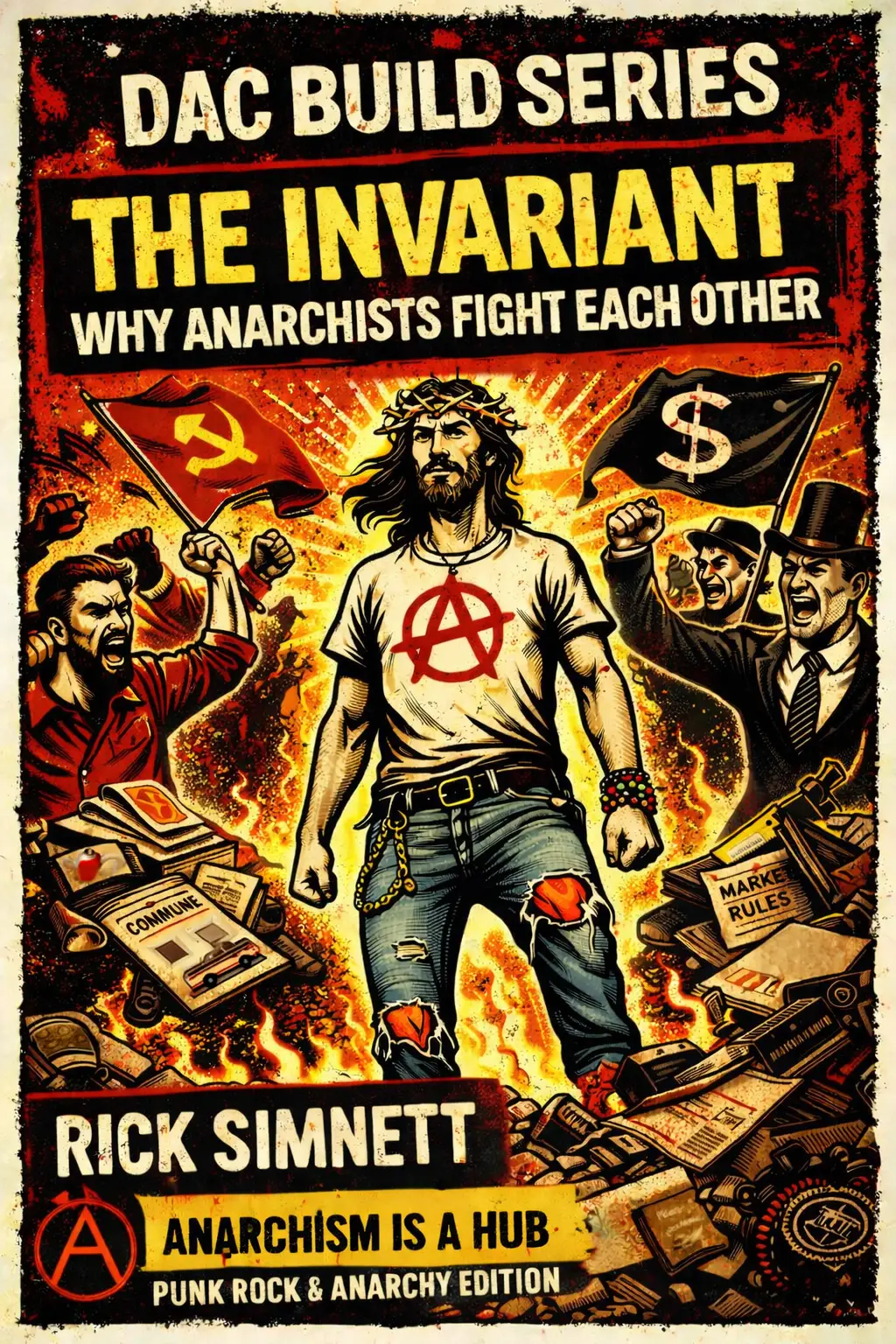
Anarchism is a “hub”.
Anarchism is not an economic program.
Anarchism is a structural constraint.
It does not tell you how to structure production.
It tells you what you are not allowed to do: rule others.
Everything else is a spoke – each deserving of its own consideration:
Anarcho-Communism
Anarcho-Capitalism
Eco-Anarchism
Feminine Anarchism
Techno-Anarchism
Crypto-Anarchism
Each spoke represents the ideas from lots of different minds that approach the problems from different perspectives.
The point is that there isn’t one “right” spoke.
And claiming there is isn’t Anarchism – it’s an attempt to insert hierarchy back into the conversation.