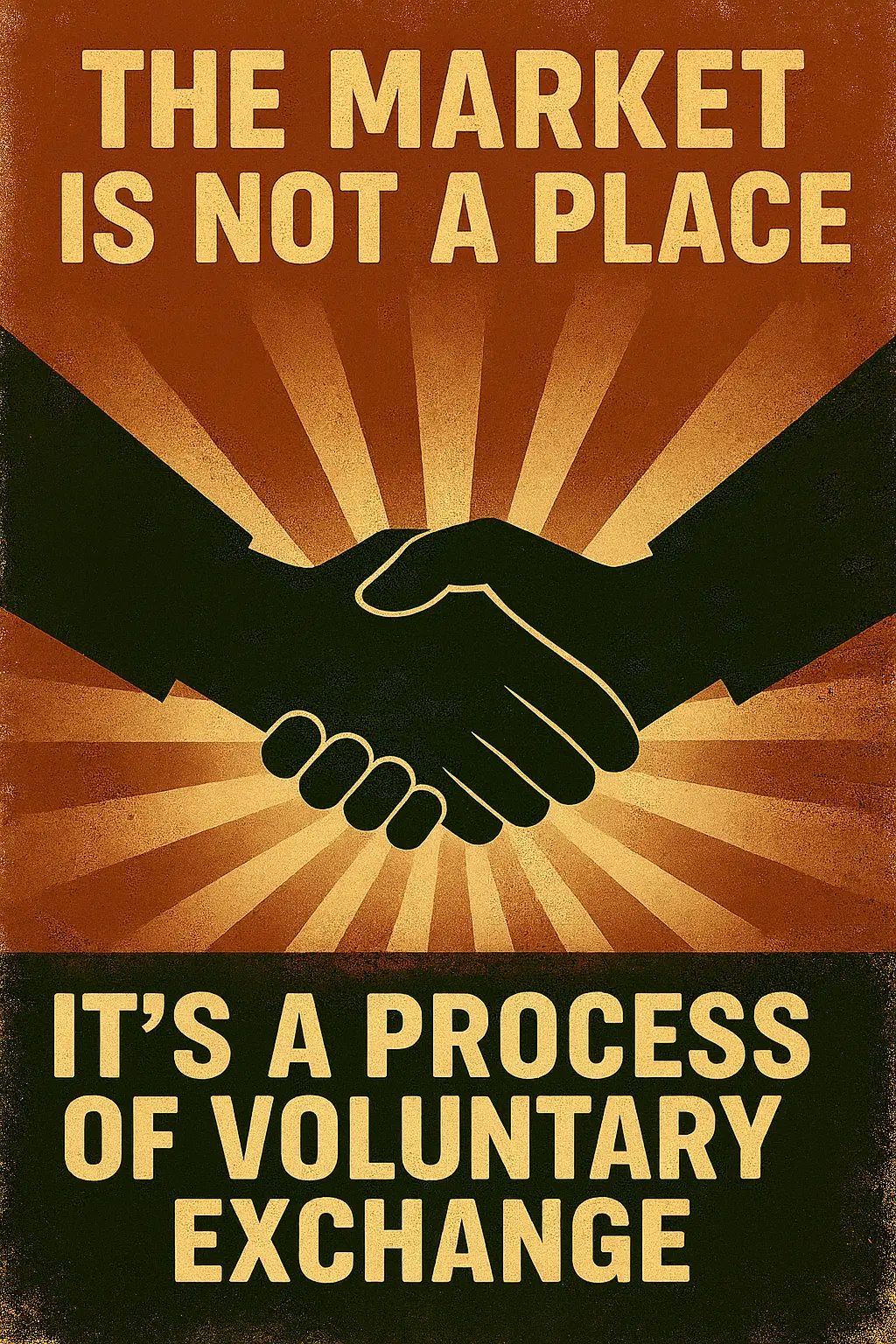

When most people hear the word market, they think of something physical: a farmer’s market, a stock exchange floor, a shopping mall. The mental image is a location — a place where buyers and sellers meet to trade goods, services, and money.
But the market isn’t defined by a set of walls, a zip code, or a street address. The market is a process. It’s the ever-changing network of voluntary exchanges between people who believe they’re better off after the trade than before.
That’s it.
No politician has to bless it. No bureaucrat has to approve it. No central committee has to plan it. The market exists anywhere two or more people agree to trade freely.
Why This Matters
If the market is just a place, it’s something that can be shut down, taxed, or regulated out of existence. If the farmer’s market is closed, the “market” disappears.
But when you see the market as a process, you understand that it’s something deeper — something that can’t be destroyed unless people lose the will or ability to trade voluntarily. Even in the most repressive regimes, black markets thrive because the process is unstoppable. Humans are natural traders. We exchange because we see value in doing so, not because someone in power told us we could.
Voluntary Exchange vs. Coercion
The magic of the market comes from the word voluntary. A voluntary exchange means each party says yes without threat or force. If I offer you ten dollars for your book and you agree, it’s because you’d rather have the money than the book. I’d rather have the book than the ten dollars. Both of us walk away richer in our own terms.
Contrast that with coercion — where one party has no choice but to comply. Taxes are the obvious example: you “pay” the government for services whether you value them or not, and refusal comes with threats, fines, or prison. That’s not a market; that’s extortion dressed up in patriotic language.
The State’s Misrepresentation of the Market
Politicians and regulators love to claim that the market is a dangerous jungle that must be tamed by the civilizing force of government. They insist that without licensing boards, trade commissions, and endless regulations, chaos would reign.
But look at how much of the so-called “market” is already distorted by the state:
- Licensing laws create artificial scarcity, keeping new competitors out.
- Regulations favor large corporations that can afford compliance teams.
- Subsidies distort demand, funneling money toward politically favored industries.
- Tariffs and trade restrictions block people from freely exchanging across borders.
These are not natural features of the market — they are imposed from outside, warping the process of voluntary exchange into something slower, costlier, and less accessible.
Decentralization: The Market’s Natural State
One of the most powerful truths about the market is that it’s decentralized. No one person or committee can map it fully, because it’s built from countless decisions made in real time by individuals and small groups.
When you buy lunch, barter services with a neighbor, or sell something online, you’re participating in the market. None of these transactions require permission from a central planner. That decentralization is exactly why markets are resilient — they adapt to new conditions faster than any government program can.
The moment one avenue of trade is blocked, another opens. This is why underground economies explode under heavy regulation: people find ways to trade around the barriers.
Real-World Examples
- E-commerce platforms connect people globally without anyone needing to ask a government for permission to shop across borders.
- Peer-to-peer payment systems let individuals send money directly to each other without banks or middlemen dictating terms.
- Local barter networks allow neighbors to exchange services without a single dollar changing hands.
All of these operate on the same principle: voluntary exchange between willing participants.
Why You Should Care
When you understand the market as a process, you start to see how often it’s interrupted, distorted, or outright sabotaged by people who claim to be “protecting” you. You also see the incredible potential when that process is left free to operate.
Innovation, abundance, and prosperity are not the results of central planning. They emerge from countless small acts of voluntary cooperation — trades, partnerships, and agreements made without force.
The Blueprint Perspective
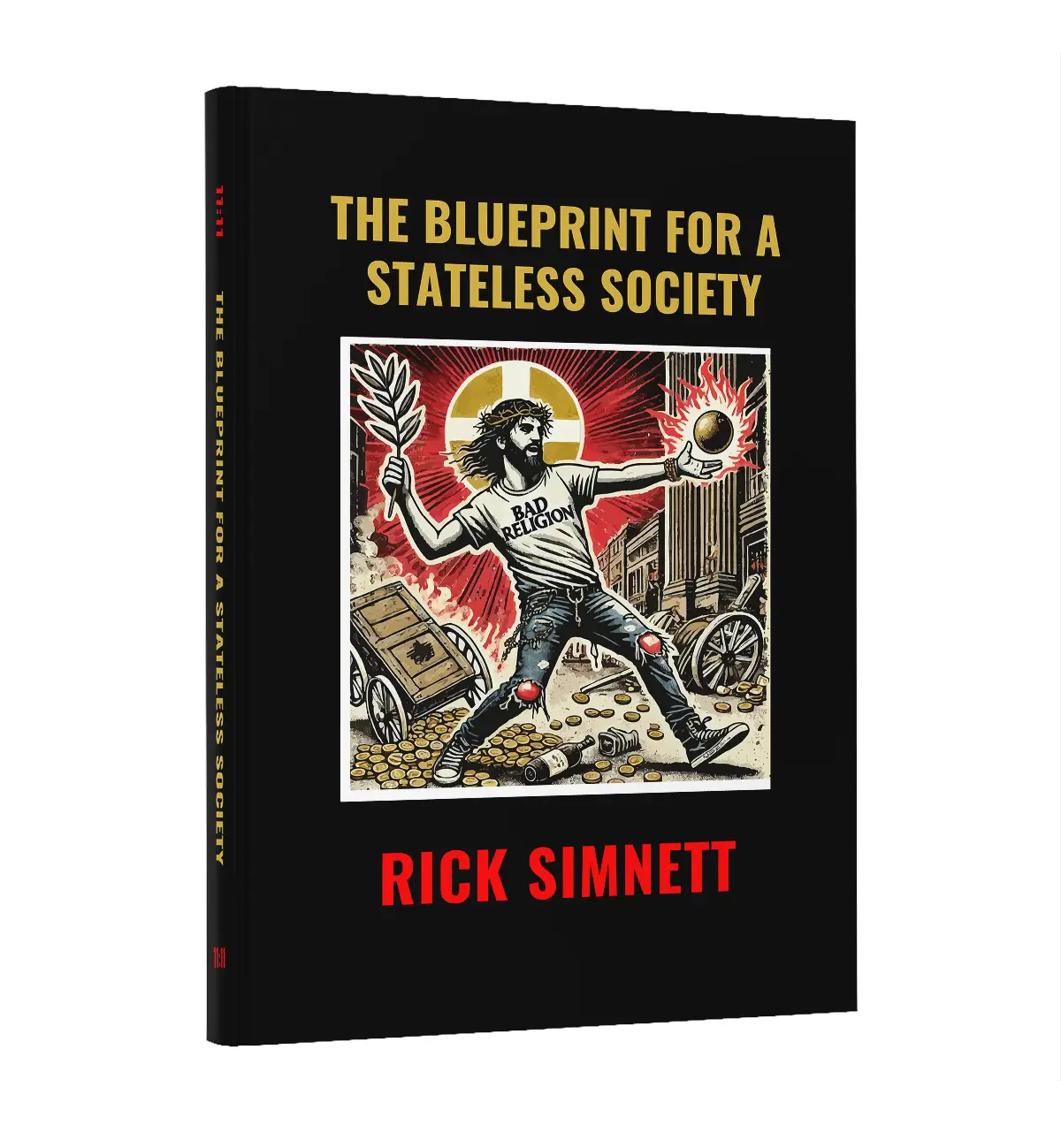
In The Blueprint for a Stateless Society, this truth is a core principle. A stateless society doesn’t mean the end of trade, innovation, or growth — it means unleashing them from the cages of coercion. It means trusting individuals to manage their own exchanges, to choose who they trade with, and to determine their own value without interference.
In such a society, “the market” is everywhere: in every handshake deal, every shared project, every exchange of goods and services. The state doesn’t set the rules — the participants do.
Like what you read?
This is exactly the kind of principle The Blueprint for a Stateless Society advocates — building systems where all exchanges are voluntary, transparent, and free from institutionalized coercion. Want to see how it scales from neighbor-to-neighbor trade to global networks? Download the Blueprint and see for yourself.