
Pre-Requisite Articles:
Deriving the Invariant
The Invariant
Agency & Identity
Coercion
Privacy
This document proposes a core model for anarchist systems — a hub of invariant constraints from which all voluntary societies (spokes) may be built.
It is published as a Request for Comments (RFC) for peer review and collaborative refinement.
This RFC aims to operationalize the definition of Anarchism.
—
Everybody loves freedom until someone leaves.
That’s when “voluntary” suddenly becomes permanent.
“You can’t quit now.”
“You owe the system.”
“What about the consequences?”
“What about the harm?”
And just like that, people start sounding like rulers.
Because if consent cannot be revoked, it was never voluntary to begin with.
But the opposite failure is just as bad.
If revocation dissolves all obligation, consent becomes meaningless.
Both fail. Every time.
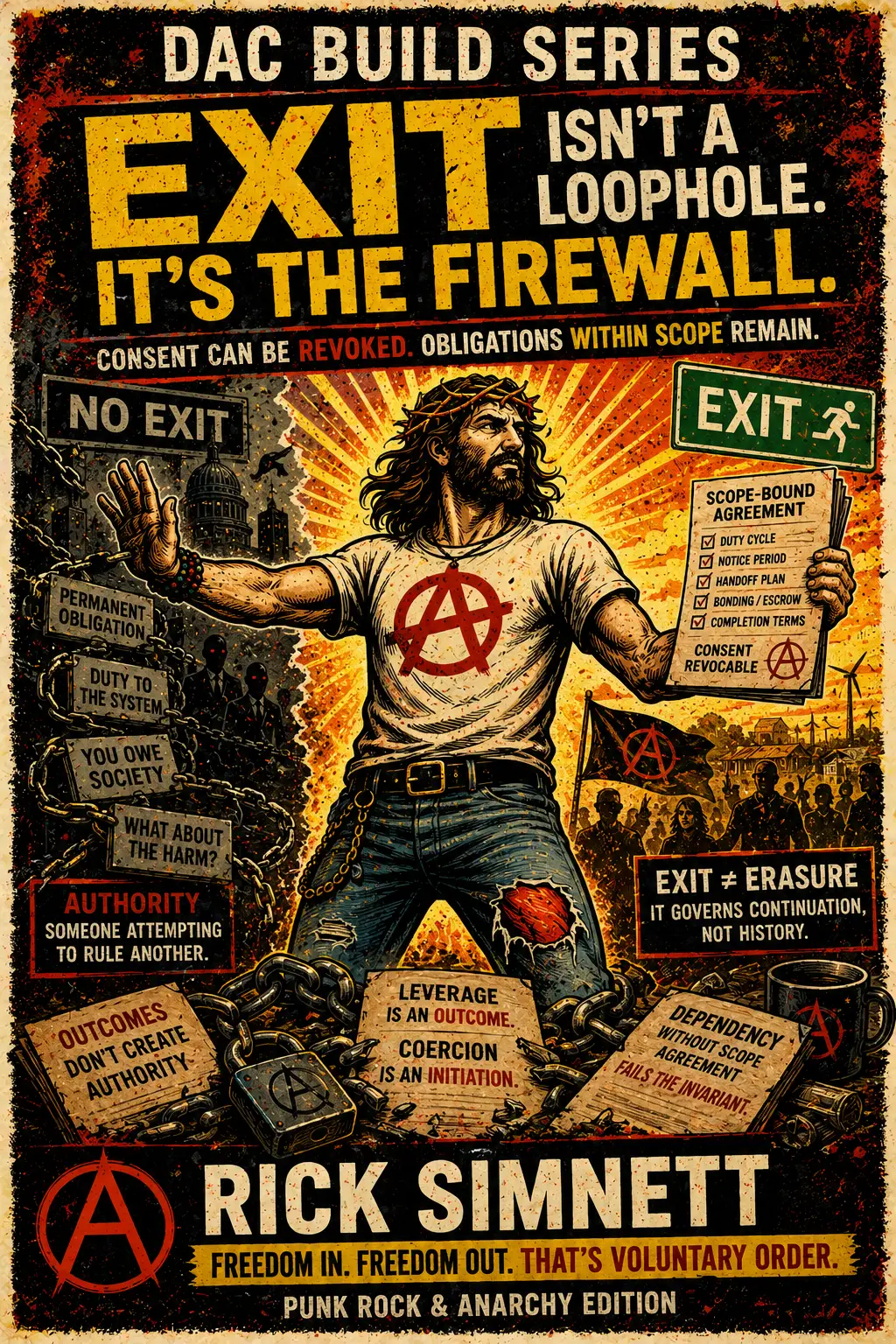
Exit isn’t a loophole.
It isn’t a magic trick for escaping accountability.
And it definitely isn’t a license to burn everything down and pretend history never happened.
Exit governs continuation.
Not erasure.
Exit isn’t a philosophy.
It’s a structural test.
Run any system against it, and the output is strictly true or false.
That distinction is the firewall that keeps voluntary order from collapsing into either:
- permanent subordination
or - total chaos
Failure Mode A: No Exit
This one is easy.
If participation cannot be revoked…
You are owned.
Call it:
- citizenship
- employment
- patriotism
- marriage
- duty to society
Structurally, it’s the same problem.
Irrevocable participation creates permanent subordination.
Permanent subordination is rulership.
If people cannot leave, the system is not voluntary.
It’s captivity with paperwork.
Failure Mode B: Absolute Exit
This is where people who mistake exit for erasure usually crash headfirst into reality.
They hear “freedom” and assume:
“I can leave whenever I want and owe nothing.”
No. That destroys continuity entirely.
If revocation nullifies obligation:
- contracts collapse
- trust collapses
- coordination collapses
Imagine hiring someone to build your house.
They take half the money.
Build half the structure.
Disappear halfway through.
Then say:
“Bro, freedom.”
That’s not freedom, that’s fraud.
Voluntary order requires enforceable scope.
Without enforceable obligation, agreements become theater.
Exit Assumes Agency
This is where the stack starts connecting together.
Exit assumes agency.
If agents are not:
- continuous
- attributable
- capable of maintaining obligation through time
then consent becomes meaningless.
Because who exactly is revoking participation?
Who carries the obligation?
Who remains accountable within scope?
If continuity disappears the moment someone changes:
- names
- accounts
- identities
- locations
then exit becomes indistinguishable from fraud.
That’s why Agency and Identity had to come before Exit in this series.
Without continuous agents, voluntary coordination cannot persist through time.
Exit Governs Continuation — Not Erasure
This is the distinction almost everybody misses.
Consent is not:
- permanent
- universal
- infinite
But obligations are not imaginary either.
Every agreement has a scope:
- explicit
- finite
- determinate
- knowable at the time of consent
Inside that scope: obligations bind.
Outside it: they don’t.
That’s the line.
If you agree to coordinate a project for thirty days, you don’t get to vanish on day five pretending your obligations disappeared.
But when the scope ends?
Exit becomes the default.
You are no longer bound to future participation.
You are only accountable for what you already agreed to.
That’s voluntary order.
The Real Problem: Outcome Worship
This is where people start drifting toward authoritarianism without realizing it.
They think sufficiently bad outcomes justify control.
“What if someone leaving causes harm?”
Good question.
Now define:
- harm
- obligation
- scope
- consent
Most people skip all of that and jump straight to:
“Someone should stop them.”
And there it is again.
Authority – someone attempting to rule another.
The Surgeon Problem
Everybody runs to the same examples:
“What if a surgeon walks out mid-operation?”
“What if an air traffic controller abandons post?”
“What if a nuclear plant operator leaves mid-shift?”
People think these are gotcha questions.
They aren’t.
They actually prove the model.
The real question isn’t:
“Would harm happen?”
It’s:
“What was disclosed within scope at the time of consent?”
That’s the test.
Scope Is Everything
If the agreement included:
- duty cycles
- notice periods
- completion requirements
- emergency handoff obligations
- bonding
- escrow
then exit may be conditionally constrained by that scope.
That’s not coercion.
That’s enforcement of previously agreed boundaries.
Huge difference.
But if no such obligation existed?
Forced continuation becomes binding without agreement.
That’s Article 1.
And it fails every time.
Because the moment participation is compelled beyond disclosed scope, voluntary order has already collapsed into rulership.
Harm Does Not Create Authority
This is where people get uncomfortable.
They think catastrophic outcomes magically justify control.
They don’t.
Catastrophic harm does not invalidate exit.
It is addressed only through pre-agreed scope mechanisms:
- bonding
- notice periods
- escrow
- duty cycles
- contractual handoff obligations
—not retroactive authority.
That distinction matters.
Because once you say:
“Bad enough outcomes justify forced participation…”
you have already recreated governance.
Now somebody has to decide:
- what qualifies as catastrophic
- when consent can be suspended
- whose obligations expand beyond agreement
- who gets forced to continue participating
That’s authority.
Not voluntary order.
Poor Planning Is Not Coercion
This line is going to piss some people off:
Voluntary order does not guarantee protection from poor planning.
It guarantees protection from undisclosed domination.
Those are not the same thing.
If your entire system depends on:
- one supplier
- one operator
- one hidden dependency
without properly defining continuity obligations that’s not a failure of exit.
That’s a failure of planning.
Or transparency.
Or scope definition.
But it is not justification for forced continuation.
Dependency Does Not Create Ownership
Dependency without scoped agreement fails the invariant.
If I voluntarily build my life around your continued participation without securing agreement… that risk is mine.
Proximity creates no new authority.
Only pre-agreed scope does.
Exit and Transparency Are Dual Constraints
This is where the architecture stack I’ve been defining fully starts locking together.
Transparency ensures consent is informed.
Exit ensures consent remains revocable.
Without transparency:
you’re signing blind.
Without exit:
you’re signing forever.
Both fail.
And both failures create hierarchy.
That’s why these constraints are not competing values.
They are load-bearing components of the same structure.
Leverage Isn’t Coercion
This one melts people’s brains.
People constantly confuse:
“I dislike the outcome”
with
“my consent was violated.”
Those are not the same thing.
Leverage is an outcome.
Coercion is an initiation.
The model only classifies initiation.
Outcomes are irrelevant to the filter.
The choice not to continue cooperation is not coercion.
Even if it hurts.
Even if it creates pressure.
Even if the consequences are severe.
Coercion begins at initiation:
- force
- fraud
- involuntary domination
Not refusal.
Not withdrawal.
Not non-participation.
Exit Is the Proof
This is the real point.
Exit isn’t a feature of voluntary order.
It’s the safeguard.
It’s the thing that proves whether a system is actually voluntary—or just pretending to be.
Because the moment participation becomes:
- permanent
- non-revocable
- enforceable beyond scope
you no longer have voluntary coordination.
You have rulers.
And the moment exit erases all obligation… you no longer have coordination at all.
You have collapse.
Only the coexistence of:
- revocable consent
and - enforceable scope
satisfies the invariant.
The Bottom Line
Exit doesn’t erase history.
It governs continuation.
That’s the line.
Not emotion.
Not outcomes.
Not fear.
Not catastrophe.
Structure.
If consent cannot be revoked, the system fails.
If obligation cannot survive revocation within scope, the system also fails.
There is no middle ground.
There never was.