
Pre-Requisite Articles:
Deriving the Invariant
The Invariant
Agency & Identity
Coercion
Privacy
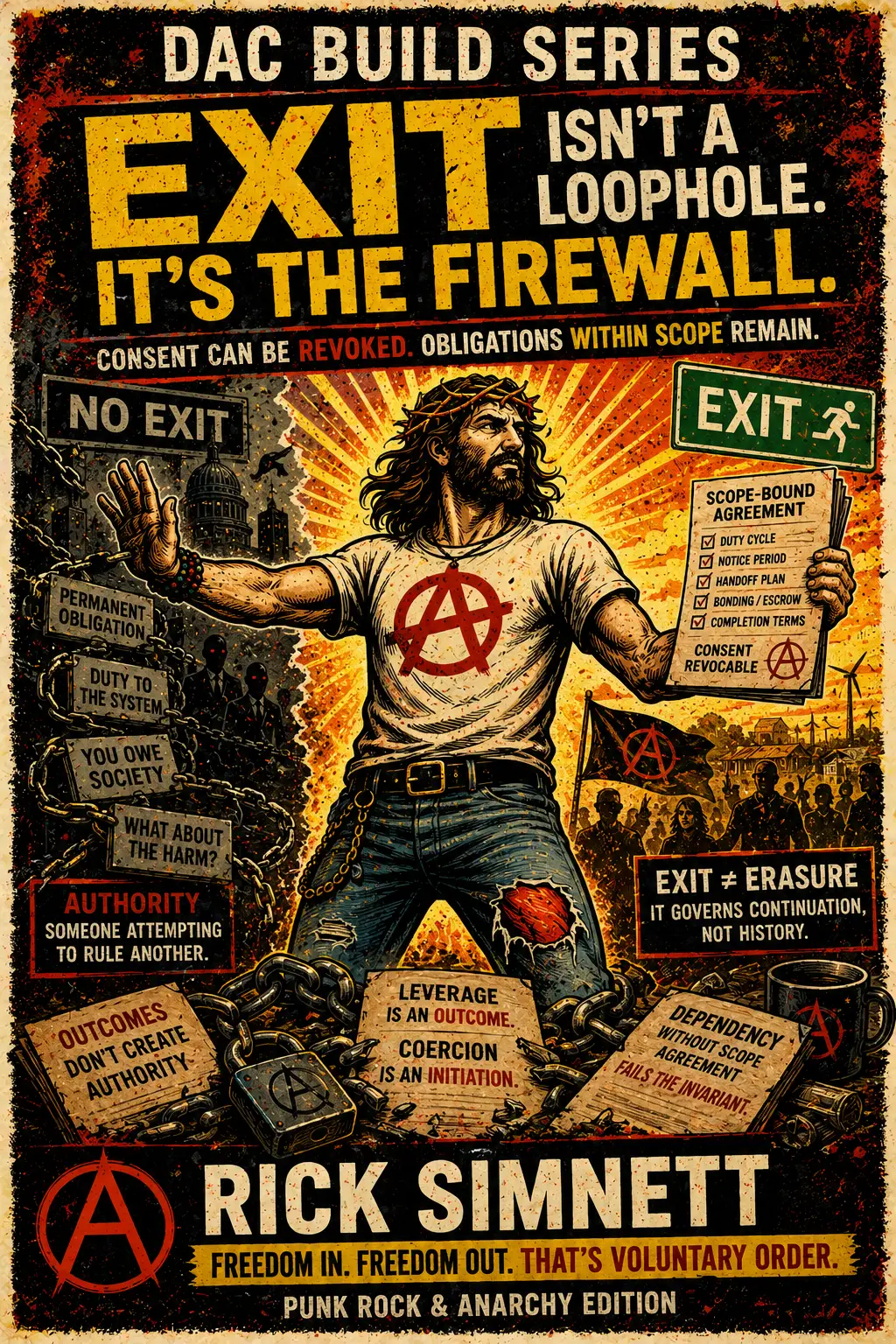
Exit
This document proposes a core model for anarchist systems — a hub of invariant constraints from which all voluntary societies (spokes) may be built.
It is published as a Request for Comments (RFC) for peer review and collaborative refinement.
This RFC aims to operationalize the definition of Anarchism.
—
People hear the word “transparency” and immediately lose their damn minds.
One side thinks transparency means:
“Tell me everything about everyone.”
The other side thinks:
“You don’t need to know shit.”
Both frames of thought fail – every time.
Because transparency is one of those concepts people pretend to understand while completely confusing:
- participation
with - existence
And if you screw that distinction up, you recreate rulers immediately.
So let’s dive into it.
Transparency Is Not Surveillance
Transparency is NOT:
- forced disclosure
- public exposure
- mandatory visibility
- “show me your DMs”
- social credit score bullshit
- algorithmic spying
- government databases
- corporate tracking
That’s not transparency.
That’s surveillance and surveillance is just authoritarianism with a prettier UI.
You don’t owe strangers unlimited access to your life just because you exist.
Sorry bro, privacy.
That was literally the previous article.
Privacy governs domain.
Transparency governs participation.
Those are not opposites.
They’re dual constraints.
Privacy protects your domain sovereignty.
Transparency protects informed consent.
Neither overrides the other.
The moment “transparency” starts overriding privacy:
you no longer have voluntary order.
You have rulers.
The Real Question
Apply the invariant:
“Voluntary order without rulers.”
Can people voluntarily coordinate if material information is hidden from them?
No.
Can people voluntarily coordinate if every part of their life is forcibly exposed?
Also no.
So transparency fails in two directions:
Failure Mode A:
Opaque systems
Failure Mode B:
Compulsory transparency
One creates hidden domination.
The other creates surveillance authority.
Both create rulers.
Transparency Is Triggered By Participation — Not Existence
This is the distinction most people completely fail to understand.
You do NOT owe transparency because you exist.
You owe transparency when you voluntarily participate in systems of coordination where information materially affects consent.
That’s the boundary.
If I:
- join your cooperative
- invest in your platform
- participate in your governance system
- enter your contractual network
…then yes, certain disclosures become necessary.
Why?
Because hidden information can invalidate consent.
But that does NOT mean:
- you get my private messages
- you get my unrelated personal history
- you get permanent access to my life
- you get surveillance authority
Wanting information does not create entitlement to it.
That distinction matters.
Because modern systems constantly abuse this boundary.
A platform says:
“We need transparency.”
Then suddenly:
- they’re monitoring everything
- collecting behavioral profiles
- tracking your relationships
- mining your communications
- selling your data
- building psychological models on you
That’s not transparency.
That’s coercive scope expansion.
And yes, that’s some authoritarian bullshit.
If The Rules Are Hidden, You’re Being Managed
This is where the transparency constraint becomes real.
Imagine joining a cooperative.
You contribute:
- money
- labor
- time
- dependency
- long-term planning
Then six months later you discover:
- leadership hid massive debt
- liabilities were concealed
- bylaws were secretly changed
- voting procedures were manipulated
- algorithmic suppression affected participation
That’s not voluntary coordination.
That’s a fucking con.
If people conceal information that materially affects participation decisions:
consent breaks.
And once consent breaks:
voluntary order collapses.
We’ve already established this fact:
Fraud is a form of coercion.
If you can’t show the real rules, you’re not running a voluntary system.
You’re running a scam with better branding.
Transparency Assumes Agency
This is where the architecture stack I’ve been defining for you starts locking together.
Transparency only works if participants are:
- attributable
- continuous
- capable of informed consent
- accountable for disclosure and concealment
Otherwise transparency becomes meaningless theater.
Because who exactly:
- disclosed the information?
- concealed the information?
- altered the rules?
- manipulated participation?
Without attributable agency:
- fraud becomes trivial
- accountability collapses
- disclosure loses integrity
Transparency assumes Agency.
That was Constraint 1.
Standing Consent Is Where Systems Become Creepy
This part is important.
When you voluntarily participate in a system, you consent to certain transparency rules.
That’s normal.
If you join a cooperative:
financial transparency matters.
If you join a governance structure:
rule transparency matters.
If you join a marketplace:
transaction transparency matters.
Fine.
But here’s where authoritarian systems always try to sneak in:
Scope expansion.
“You agreed to transparency.”
Cool.
Did I agree to:
- unlimited monitoring?
- behavioral profiling?
- surveillance?
- data resale?
- perpetual disclosure?
- unrelated informational access?
No.
That’s the trick.
Standing consent cannot expand beyond agreed scope.
The moment systems unilaterally expand disclosure requirements beyond original agreement:
they violate consent.
That’s not transparency anymore.
That’s coercion.
The Opposite Failure Is Just As Bad
Now let’s kill the other dumb argument.
Some people hear all this and think:
“See? Nobody owes anybody any information ever.”
Wrong.
That collapses coordination completely.
You cannot have voluntary systems if:
- contracts are hidden
- liabilities are concealed
- governance rules are secret
- algorithms manipulate outcomes invisibly
- participants cannot evaluate risk
That’s not freedom.
That’s asymmetrical manipulation.
Transparency exists to preserve informed consent within participation systems.
Not to eliminate privacy.
Not to create surveillance.
Not to expose existence itself.
Just enough disclosure to preserve voluntary coordination.
That’s the line.
Algorithmic Transparency Matters More Than Ever
Modern people should understand this immediately.
Platforms constantly claim neutrality while secretly manipulating:
- visibility
- ranking
- reach
- monetization
- suppression
- discoverability
If participation outcomes are being materially altered by hidden systems – participants are no longer consenting to actual conditions.
They’re consenting to a fiction.
And no, hiding the rules in a 47-page Terms of Service nobody reads doesn’t magically make that voluntary.
Governments love this game too, by the way.
“Sure, you’re free.”
Right up until:
- hidden regulations
- secret interpretations
- undisclosed enforcement
- arbitrary rule changes
- selective application
suddenly appear out of nowhere.
Funny how “transparency” always seems to apply downward, but never upward.
Transparency Without Privacy Creates Surveillance
This is the line modern society keeps blowing past.
Transparency cannot override privacy.
Ever.
The moment disclosure exceeds material participation scope:
surveillance emerges.
And surveillance ALWAYS creates informational hierarchy.
Whoever controls:
- visibility
- disclosure
- monitoring
- access
- interpretation
eventually controls participation itself.
That’s power.
That’s authority.
That’s rulership.
And yes…
social media companies, governments, banks, and corporations are all doing this shit constantly.
The Real Principle
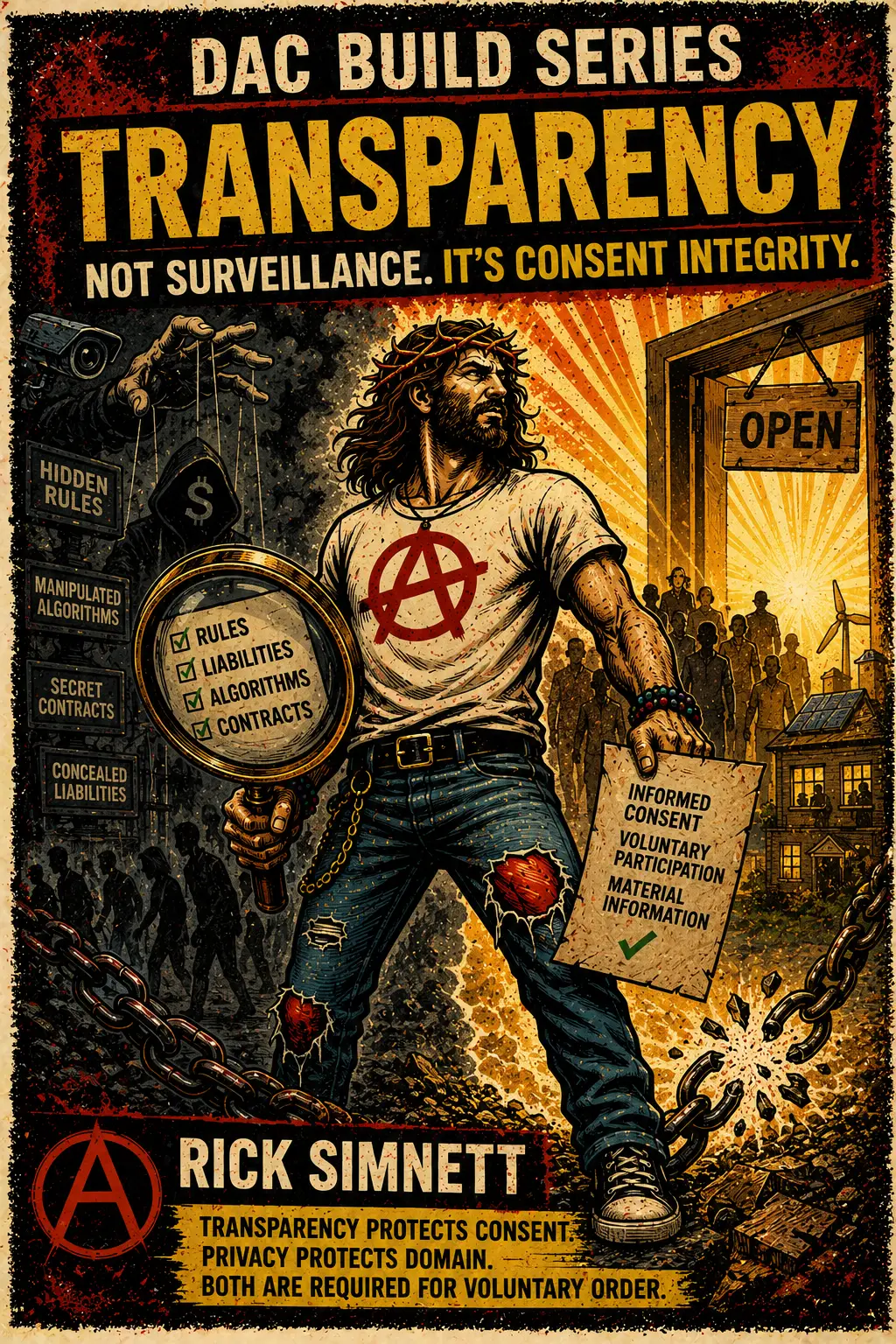
Transparency protects consent integrity.
Privacy protects domain sovereignty.
Exit protects consent revocability.
Together, they stop voluntary systems from calcifying into:
- hidden hierarchy
- surveillance authority
- informational coercion
- permanent asymmetry
That’s the architecture stack I’ve been defining throughout this RFC series.
These aren’t competing values.
They’re structural boundaries.
And every single one exists for one reason:
To preserve voluntary order without rulers.
The Bottom Line
Without transparency:
systems degrade into hidden domination.
With absolute transparency:
systems degrade into surveillance authority.
Only consent-bound transparency survives the invariant.
You owe transparency when you voluntarily participate in systems where information materially affects consent.
You do not owe transparency because you exist.
That’s the line.
Everything beyond that becomes rulership.