
Your Anarchism Isn’t Going To Take Over The World
It was never meant to.
If you think it was – you need to re-examine what anarchism is.
You have to accept no rulers means that nobody HAS to do anything they don’t want to do.
You have to accept people will group as they choose to — not how they’re told to.
Yet somehow those groups still need to trade, cooperate, resolve disputes, and coordinate without one becoming sovereign over the others.
That’s called Interoperability.
Most anarchists secretly believe the same thing every government believes:
“Our system will eventually win.”
Maybe you’ve noticed it.
The communists think everybody will eventually become communists.
The anarcho-capitalists think everybody will eventually become anarcho-capitalists.
The syndicalists think everybody will eventually join the union.
The mutualists think everybody will eventually figure out they’re right.
Everybody imagines their preferred system expanding until it becomes the system.
Funny thing about that is…
That’s exactly how governments think.
That’s exactly how empires think.
And that’s exactly how rulership starts.
If anarchism means without rulers, then no system gets to become sovereign over everybody else.
Not yours.
Not mine.
Not anyone’s.
Which means the real question isn’t:
“Which system wins?”
The real question is:
How the hell do different systems coexist without one eventually trying to rule the others?
That’s the interoperability problem.
And if you can’t solve it, your stateless society doesn’t scale.
It just breaks into tribes.
The Dirty Secret About Most Political Movements
Most political movements aren’t actually trying to solve coexistence.
They’re trying to solve conquest.
They just call it something nicer.
They don’t ask:
“How do we live together?”
They ask:
“How do we get everybody to adopt our rules?”
Different sales pitch.
Same destination.
The state does this through force.
Ideological movements often do it through social pressure.
The mechanism changes.
The goal doesn’t.
Universal compliance.
Universal norms.
Universal authority.
In other words:
Rulership.
The Problem With “Just Leave”
Some anarchists think the answer is simple.
“If you don’t like it, leave.”
Cool.
Leave and go where?
What happens when:
you want to trade with somebody outside your system?
you want to hire somebody outside your system?
you want to resolve a dispute with somebody outside your system?
you want to cooperate across boundaries?
Now what?
Because the second different systems start interacting, somebody has to answer a question:
Whose rules apply?
And if the answer is: “Ours.”
You just recreated a government.
Congratulations.
The Important Insight
The systems don’t interact:
The people do.
That’s the breakthrough.
The systems aren’t the primitive.
The agents are.
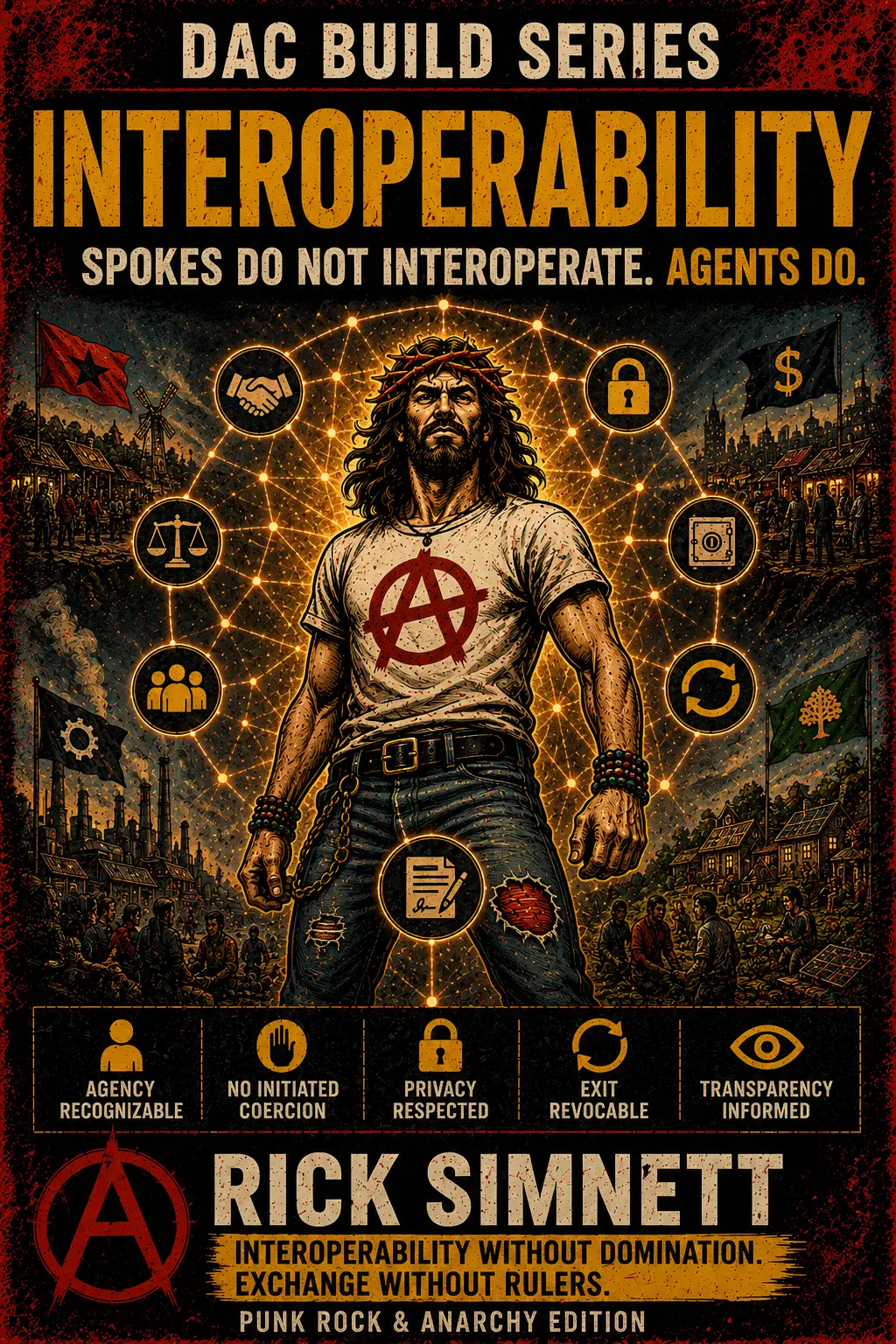
Spokes do not interoperate.
Agents do.
That means Alice doesn’t need to become a collectivist to trade with Bob.
Bob doesn’t need to become a capitalist to trade with Alice.
Neither side has to surrender their beliefs.
Neither side has to abandon their internal rules.
They simply need an agreement governing that interaction.
Nothing more. Nothing less.
Rules Are Not Sovereignty
This is where people get confused.
Let’s say you’re from System A.
You agree to arbitration under System B.
Did System B become your ruler?
No.
You referenced their rules.
You didn’t surrender your sovereignty.
Big difference.
Referencing rules is a choice.
Submission is not.
That’s why jurisdiction must be contractual.
Never territorial.
Because territorial jurisdiction always becomes:
“You live here, therefore you obey.”
That’s state logic.
Anarchism starts from a different premise:
“You agreed to this, therefore you’re bound by this.”
Huge difference.
Global Trade Does Not Require Global Government
This is another place where people have been conditioned to think like subjects.
People assume large-scale coordination requires large-scale authority.
It doesn’t.
The internet already proved this.
Different networks, providers, organizations and protocols all interact constantly without a universal ruler.
The interaction happens because the protocols are compatible.
Not because somebody owns the entire thing.
The same principle applies here.
Global exchange does not require global law.
It requires consent.
That’s it.
The Hardest Problem: Enforcement
This is where critics usually start smiling.
“Yeah Rick, but what happens when somebody doesn’t comply?”
Good question.
Let’s say:
Alice lives in System A.
Bob lives in System B.
They agree:
arbitration under System C
escrow in System D
reputation tracking in System B
A dispute happens.
The arbitration runs. The escrow releases. The reputation system updates.
Nobody invaded anybody.
Nobody claimed sovereignty.
Nobody needed territorial authority.
Because authority was delegated beforehand.
That’s the entire trick.
The state assumes authority.
Voluntary systems require authority to be delegated.
The Two Ways Interoperability Fails
Failure Mode #1:
Universalism.
One system decides everybody should live under its rules.
Congratulations.
You just reinvented the state.
Failure Mode #2:
Isolationism.
Nobody interacts with anybody outside their ideological bubble.
Congratulations.
You just reinvented tribalism.
Both fail. Every time.
One becomes empire. The other becomes fragmentation.
Interoperability is the narrow path between them.
Why This Matters
Interoperability creates something politicians hate:
Competition.
If people can leave, trade, coordinate and cooperate across systems…
then systems have to earn participation.
Bad systems lose people.
Coercive systems lose people.
Opaque systems lose trust.
Rigid systems lose relevance.
Not because somebody overthrew them.
Because people walked away.
Scale is permitted.
Empire is not.
That’s the distinction.
The Bottom Line
Most people think anarchism is about building the perfect system.
I think that’s wrong.
The goal isn’t to build one perfect spoke.
The goal is to create rules that allow many different spokes to coexist without one ruling the others.
That’s the interoperability constraint.
Because if your system only works after everybody adopts it… you didn’t solve rulership.
You just changed who sits on the throne.
Spokes do not interoperate.
Agents do.
And agents may only bind themselves.
Never others.